
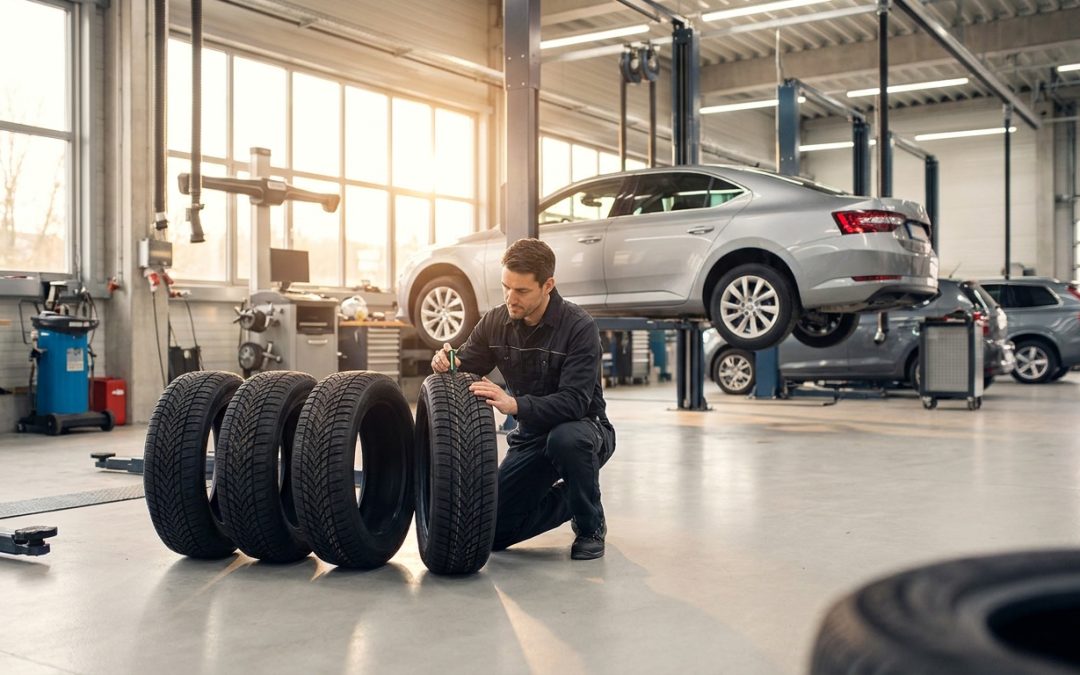
It’s a common moment: you notice uneven tread, a puncture that can’t be repaired, or a tire that’s worn down faster than expected. The shop quotes you two new tires, and it sounds like the sensible, budget-friendly move. But in many real-world situations, replacing all four tires at once isn’t just “nice to have”—it can be the smarter decision for safety, handling, long-term cost, and even drivetrain health. The key is understanding how tires work together as a set and what happens when they don’t match.
How Tires Work as a Team (and What Happens When They Don’t)
Your vehicle doesn’t drive on “a tire.” It drives on four contact patches, each roughly the size of a postcard. Those four patches share braking, acceleration, cornering, and stability responsibilities. When all four tires are similar in tread depth, construction, and grip, the car responds predictably. When they’re mismatched, the vehicle can feel unsettled—especially in emergency maneuvers or poor weather.
A common misconception is that two new tires “fix” the problem. They can help, but they also introduce new variables. New tires have deeper tread, often a different rubber compound (especially if you change brands/models), and sometimes a different rolling radius. That difference changes how weight transfers and how the vehicle’s stability systems interpret wheel speed and traction.
Even if the tire size printed on the sidewall matches, the real-world circumference can vary with tread depth and design. A brand-new tire might have 10/32″ of tread, while your remaining pair might be at 4/32″. That difference can be enough to change how the car behaves in rain and can cause unnecessary strain on some drivetrains.
Traction Imbalance: Why It Matters in Emergencies
In normal commuting, you might not notice traction imbalance. But in a panic stop, a sudden lane change, or a wet on-ramp, the weakest tires dictate your limits. If the rear tires have significantly less tread than the fronts, the rear may lose grip first, increasing the risk of oversteer (the back end stepping out). If the front tires are the weaker pair, you may experience understeer (plowing straight) when you need the car to turn.
Modern ABS and stability control help, but they can’t create traction that isn’t there. They manage slip by reducing power or braking certain wheels, but if two tires are far more capable than the other two, the systems may intervene more often and more aggressively—sometimes in ways that feel surprising to the driver.
Ride Comfort and Noise: The Subtle Clues
Mismatched tires can also change ride quality. Different tread patterns and rubber compounds produce different noise frequencies. If you replace two tires with a different model, you may notice a new hum at highway speeds or a change in how the car reacts to expansion joints and rough pavement.
Vibration complaints after “just two new tires” are also common. Sometimes it’s a balancing issue, but sometimes the new tires simply don’t match the rolling characteristics of the older pair. Replacing all four at once reduces the chance of chasing a comfort problem that wasn’t there before.
Safety First: Braking, Hydroplaning, and Stability Control
If there’s one category where four tires frequently beat two, it’s safety. Tires are the only part of your car that touches the road, and the difference between “okay” and “excellent” traction can be measured in car lengths—especially on wet pavement.
As tires wear, their ability to evacuate water decreases. Tread grooves act like channels that push water away from the contact patch. With shallow tread, water can’t move out fast enough, and the tire begins to ride on top of the water film (hydroplaning). This can happen at lower speeds than many drivers expect, especially with standing water.
When you replace only two tires, you may improve hydroplaning resistance on one axle while leaving the other axle vulnerable. That mismatch can create unpredictable behavior: the “good” axle grips while the “worn” axle floats, potentially destabilizing the vehicle during braking or cornering.
Real Example: Wet Highway Braking
Imagine a front-wheel-drive sedan with two new tires installed on the front and two worn tires remaining on the rear. In a sudden wet braking event, the front tires can maintain grip and slow the car effectively, while the rear tires may begin to hydroplane earlier. The result can be a rear-end wiggle or a sense that the car is trying to rotate. Even if stability control steps in, it may not fully prevent a loss of control if the rear tires are far behind in water evacuation.
Now flip the scenario: new tires on the rear and worn on the front. Braking distances may be longer because the front tires do most of the braking work. The vehicle might stay straighter, but you may still need more distance to stop. In both cases, the mismatch forces a trade-off. Four new tires reduce that compromise.
How ABS and Traction Control React to Mismatched Grip
ABS works by preventing wheel lock-up, and traction control reduces wheel spin. Both systems assume tire behavior is relatively consistent across the vehicle. When two tires have significantly different grip or rolling radius, the systems can interpret normal conditions as slip, or they may intervene unevenly. That can feel like delayed acceleration, unexpected braking pulses, or stability control activating sooner than it used to.
While these systems are designed to handle many conditions, they are not a substitute for a balanced set of tires. A matched set helps your electronic safety systems do their job with fewer surprises.

All-Wheel Drive and 4WD: The Hidden Cost of Mismatched Tread
If you drive an AWD or 4WD vehicle, replacing all four tires is often more than a recommendation—it can be a requirement to avoid drivetrain stress. Many AWD systems rely on consistent tire circumference so differentials and transfer cases aren’t forced to compensate for constant speed differences between axles.
When one axle (or one wheel) has a different rolling radius, it effectively spins at a different rate. The drivetrain interprets that as slip and tries to correct it. Over time, that can create heat, wear, and premature failure in components that are expensive to repair.
Some manufacturers specify a maximum allowable tread depth difference (often around 2/32″ to 3/32″ between tires). Exceed it, and you may risk drivetrain damage or even warranty issues. This is one of the strongest arguments for buying four tires at once—because the cost of “saving” on two tires can be dwarfed by a repair bill later.
What If Only One Tire Is Damaged?
Sometimes you have three tires in good shape and one that’s unrepairable. In AWD/4WD vehicles, the best option might still be four new tires—unless you can match the replacement tire closely to the others in brand, model, and tread depth.
In certain cases, tire shaving (reducing tread depth on a new tire to match the others) can be a practical solution. Not every shop offers this, and it’s not appropriate for every situation, but it can help you avoid replacing all four when the other three are still relatively fresh.
Actionable tip: if you drive AWD/4WD, ask the shop to measure and document tread depth on all four tires before deciding. If the difference is beyond your manufacturer’s limit, strongly consider replacing all four or using a shaved tire option if available.
Common AWD Scenarios Where Four Tires Make Sense
Replacing all four is especially smart when your remaining tires are already moderately worn. If you’re at 5/32″ or less on the “good” tires and you install two new ones at 10/32″, you’re creating a large gap that can be hard on the system and inconsistent in wet traction.
It’s also wise if you frequently drive in rain, snow, or on mixed surfaces. AWD can help you get moving, but it doesn’t improve braking on slick roads if your tires can’t grip. Four matched tires give AWD the foundation it needs to work as intended.
Cost Reality: Why Four Tires Can Be Cheaper Over Time
At first glance, buying four tires costs more than buying two. But the more accurate question is: what does it cost per mile, and what secondary costs might appear if you only replace two? When you factor in tire life, alignment, rotations, fuel economy, and the risk of uneven wear, four tires often come out ahead.
One common pattern is this: you replace two tires today, then 6–12 months later you replace the other two. That means you pay mounting and balancing twice, you may pay disposal fees twice, and you’re more likely to end up with a “staggered” set of tires at different wear stages. It can also complicate rotations because you’re trying to manage two different tread depths and sometimes two different tire models.
Additionally, new tires sometimes reveal existing alignment issues because the old tires wore in a way that “masked” the problem. If you only replace two, you may see rapid wear on the new pair, shortening their lifespan and erasing the initial savings.
Practical Math: The Two-Tire Cycle Trap
Here’s a realistic example. Suppose a set of four tires lasts 45,000 miles with proper rotation and alignment. If you replace only two at 30,000 miles because the fronts wore faster, you now have two new tires and two older tires. Rotations become less effective, and you may find yourself replacing the older pair at 40,000 miles and the newer pair again at 70,000–75,000 miles—often with extra service costs along the way.
Compare that to replacing all four at 45,000 miles: one purchase, one alignment check, consistent rotations, and a predictable replacement interval. For many drivers, that predictability is valuable—especially if you’re budgeting for maintenance or planning a long trip.
Fuel Economy and Rolling Resistance
Tires with different tread depths and compounds can have different rolling resistance. While the fuel economy difference may not be dramatic, it can add up over thousands of miles. More importantly, mismatched rolling characteristics can cause the vehicle to feel like it “drags” or pulls slightly, prompting drivers to compensate with steering input and throttle. A matched set helps the vehicle roll smoothly and efficiently.
Actionable tip: if fuel economy is a priority, choose a tire model known for low rolling resistance and replace in a full set so the vehicle’s rolling behavior is consistent corner to corner.
Handling, Rotation, and Tire Life: Getting the Most from Your Set
Tire rotation is one of the simplest ways to extend tire life, but it works best when all four tires are the same model and similar tread depth. Rotating equalizes wear across positions, helping you reach the tire’s expected mileage. When you have two new and two old, rotations become less effective because you’re trying to balance different starting points.
Handling is also more consistent with four matching tires. Steering feel, cornering grip, and braking response depend on predictable traction. When one axle behaves differently than the other, the vehicle can feel “off,” especially at highway speeds or on sweeping turns.
Replacing all four at once also gives you a clean slate for maintenance. You can establish a rotation schedule (often every 5,000–7,500 miles, or per your vehicle’s recommendations), keep pressures consistent, and monitor wear patterns to catch alignment or suspension issues early.
Real Example: The “New Front Tires” Steering Surprise
A common scenario is installing two new tires on the front of a front-wheel-drive car. The driver may notice sharper turn-in and more grip up front, but the rear feels looser in the rain. That sensation isn’t imaginary—it’s the result of the front tires having more tread depth and often more lateral grip than the rear tires.
Some drivers then respond by driving more aggressively because the steering feels better, which can further expose the rear tires’ limitations. Four new tires keep the vehicle’s balance more neutral and predictable, reducing the chance of being caught off guard.
Actionable Maintenance Tips to Maximize Four New Tires
- Check and set tire pressure monthly (and before long trips). Underinflation accelerates shoulder wear and increases heat.
- Rotate on schedule to equalize wear, especially on front-wheel-drive vehicles where the front tires work harder.
- Get an alignment check when installing new tires. Even a slight toe issue can chew through tread quickly.
- Inspect suspension components if you see cupping, scalloping, or rapid inner/outer edge wear.
- Track tread depth with a simple gauge so you can plan replacements before traction drops off.
These steps help ensure that buying four tires delivers the full benefit: longer life, better performance, and fewer surprises.
When Replacing Two Tires Can Be OK (and How to Do It Safely)
There are situations where replacing only two tires is reasonable—particularly if the other two are still relatively new and the overall set remains balanced. The goal is to avoid large differences in tread depth, grip, and construction that could affect safety or drivetrain function.
If you do replace two, placement matters. Many tire professionals recommend putting the new tires on the rear, regardless of whether the vehicle is front-wheel drive, rear-wheel drive, or AWD. The logic is stability: better rear traction reduces the risk of oversteer and helps the vehicle track straight in wet conditions. This recommendation can surprise drivers who assume the drive wheels should get the best tires.
That said, AWD/4WD vehicles may have stricter requirements. If your manufacturer limits tread depth differences, you must follow those guidelines even if it means replacing all four.
Checklist for Safely Replacing Only Two
- Measure tread depth on all tires. If the remaining pair is close in depth to the new pair (often within 2/32″ to 3/32″ depending on vehicle), two may be fine.
- Match the exact tire model if possible (same brand, model, size, and speed/load rating). Mixing models can change handling and noise.
- Install the new tires on the rear to improve stability in wet conditions (unless your vehicle manufacturer states otherwise).
- Verify alignment so the new tires don’t wear out prematurely.
- Plan the next replacement so you don’t end up with a constantly mismatched set.
If your budget is the deciding factor, talk with the shop about value-focused tire options, rebates, or financing. Often, the jump from two to four is smaller than expected once promotions are applied, and it may save money by reducing future service visits.
Seasonal Considerations: Don’t Mix Winter and All-Season Tires
Another important exception: avoid mixing winter tires with all-season or summer tires on the same vehicle. Winter tires have dramatically different traction characteristics, especially in cold temperatures. Mixing them can create severe imbalance in grip and braking behavior.
If you run winter tires, it’s best practice to install four winter tires as a set. If one winter tire is damaged and the others are worn, you may need to replace all four or use a tread-matched replacement to keep the set consistent.
Conclusion: The Smart Case for Four Tires at Once
Replacing four tires at once isn’t just a “premium” choice—it’s often the most practical way to protect safety, performance, and your long-term budget. A matched set improves braking consistency, reduces hydroplaning risk, and keeps handling predictable when conditions change. It also helps your vehicle’s stability and traction systems work the way they were designed to.
For AWD and 4WD drivers, four tires can be especially important because mismatched tread depth can strain drivetrain components and lead to costly repairs. Even for front- or rear-wheel-drive vehicles, four tires simplify rotations, reduce uneven wear, and often lower the total cost of ownership by avoiding the two-tire replacement cycle.
Key takeaways:
- Four matching tires deliver the most predictable handling, braking, and wet-weather stability.
- AWD/4WD vehicles are particularly sensitive to tread depth differences—measure before deciding.
- Two-tire replacements can work when tread depths are close and the tires are properly matched and installed (often new tires on the rear).
- Long-term value often favors four tires due to better rotation strategy, fewer service visits, and reduced risk of premature wear.
If you’re on the fence, ask for tread depth readings, discuss your driving conditions (rain, snow, highway commuting), and consider how long you plan to keep the vehicle. In many cases, buying four tires at once is the decision you’ll feel good about every time the road gets slick, traffic stops suddenly, or you need your vehicle to respond with confidence.