

You’re driving along, everything feels fine, and then it happens: the ABS warning light pops on. The brake pedal feels normal. Stopping distance seems unchanged. No grinding, no pulling, no drama. So why is the car telling you something’s wrong?
An ABS light that stays on while the brakes still feel “normal” is common—and it’s also easy to misunderstand. In many cases, your regular hydraulic braking system is working as designed, but the anti-lock braking system (ABS) has detected a fault and disabled itself. That means you may still be able to stop safely in everyday conditions, yet you’ve lost an important safety layer for hard braking, slick roads, and emergency maneuvers.
This guide breaks down what the ABS light really means, why the brakes can feel fine anyway, what could be causing the warning, and how to troubleshoot it responsibly. You’ll also learn practical next steps, real-world examples, and when it’s safe to drive versus when you should park the vehicle and get help.
What the ABS Light Means (and Why Brakes Can Still Feel Normal)
ABS is designed to prevent wheel lockup during heavy braking. When a wheel locks, it can slide, reducing steering control and often increasing stopping distance on wet, icy, or loose surfaces. ABS rapidly modulates brake pressure—many times per second—so the tires maintain traction and you can still steer.
When the ABS control module detects a fault (like a bad wheel speed signal or an electrical issue), it typically turns on the ABS light and disables ABS functionality. Importantly, most vehicles are engineered so the base braking system still works even if ABS fails. That’s why the pedal can feel normal and braking can seem unchanged in routine, dry-road stops.
Think of ABS as an “assist” layer rather than the foundation. The foundation is the master cylinder, brake booster, calipers, pads, rotors/drums, and hydraulic lines. If those components are healthy, your everyday braking can remain strong even with ABS offline. The catch is that you may not notice the difference until you need ABS the most—panic braking, a slick intersection, or an evasive maneuver.
ABS vs. Traction Control vs. Stability Control
Many modern vehicles share sensors and modules between ABS, traction control (TCS), and electronic stability control (ESC). A fault that triggers the ABS light can also disable TCS/ESC, sometimes lighting additional icons (a skidding car symbol, “TRAC,” “ESP,” or “VSC”). Even if only the ABS light is on, the underlying issue may affect these systems too.
That’s why it’s worth taking the warning seriously even if the car “feels fine.” Losing stability control assistance can matter just as much as losing ABS—especially in rain, snow, gravel, or sudden lane-change situations.
What You Might Notice When ABS Is Actually Needed
On a slippery surface, you might feel the wheels lock and the car slide rather than feeling the familiar ABS pulsing in the pedal. In an emergency stop, the vehicle may be harder to steer around an obstacle. Some drivers only discover ABS is disabled when they hit a wet patch and the tires chirp or skid under hard braking.
Practical tip: If you’re in a safe, empty area with good visibility (like a large empty lot) and you have experience, you can do a gentle test on a low-traction surface to see whether ABS engages. But never attempt aggressive testing on public roads, and avoid any test if road conditions or space are not ideal.
Common Causes: Why the ABS Light Turns On
ABS faults often come down to sensor signals, wiring, or module power/communication. The system relies on accurate wheel speed data, stable voltage, and clean electrical connections. A small issue—like a cracked sensor wire—can trigger the light even though the mechanical brakes are fine.
Below are the most common culprits. The exact cause depends on your vehicle, mileage, climate, and recent service history (tire rotations, brake jobs, suspension work, or battery replacement can all be relevant).
1) Wheel Speed Sensor Failure (Most Common)
Each wheel typically has a speed sensor that reads a tone ring (also called a reluctor ring) to measure wheel rotation. If one sensor fails or sends an erratic signal, the ABS module can’t reliably control braking, so it shuts ABS off and turns on the light.
Real example: After a winter storm, road salt and slush build up around a front wheel sensor. Corrosion creeps into the connector, causing intermittent dropouts. The ABS light comes on randomly, especially after hitting puddles. The brakes feel normal—until a slick stop reveals the wheels can lock.
Actionable advice: If the light is intermittent (on sometimes, off sometimes), suspect a sensor or wiring issue rather than a complete module failure. Intermittent faults are often triggered by moisture, vibration, or steering angle changes.
2) Damaged or Corroded Wiring/Connectors
Wheel sensor wiring lives in a harsh environment: water, heat, rocks, road debris, and constant suspension movement. A wire can chafe through, a connector can loosen, or corrosion can increase resistance. Any of these can distort sensor signals and trigger the ABS light.
Real example: A vehicle gets a tire rotation at a shop. The technician inadvertently tugs the sensor harness while removing the wheel. Weeks later, the ABS light appears because the harness has a partially broken conductor that fails when the suspension compresses.
Actionable advice: A careful visual inspection behind each wheel—looking for broken clips, stretched wires, or green corrosion in connectors—can reveal obvious problems. If you’re not comfortable removing wheels, ask a shop to check harness routing and connectors during a brake inspection.
3) Tone Ring/Reluctor Ring Issues (Rust, Cracks, Missing Teeth)
The wheel speed sensor reads a toothed or magnetic ring. If the ring is cracked, rusty, or has missing teeth, the sensor sees inconsistent wheel speed. That inconsistency looks like a skid event or a sensor fault, so the ABS system may disable itself.
On some vehicles, the tone ring is integrated into the wheel bearing/hub assembly. On others, it’s part of the CV axle or brake rotor. In rust-prone regions, a tone ring can swell with rust, crack, and distort the signal.
Actionable advice: If your ABS light appeared along with a subtle clicking noise, vibration, or wheel bearing hum, the issue may be in the hub/bearing assembly where the tone ring lives. This is especially common at higher mileage.
4) Low Battery Voltage or Charging System Problems
ABS modules are sensitive to voltage. A weak battery, failing alternator, or poor ground connection can cause the ABS module to throw a fault—even if the vehicle still starts and drives. You may see the ABS light after a cold start, after jump-starting, or when electrical loads are high (headlights, defroster, heated seats).
Real example: A battery is near end-of-life. The car starts, but voltage dips during cranking. The ABS module logs a low-voltage code and illuminates the ABS light. Later, it may go off after the alternator recharges the battery, leading to confusing on-and-off behavior.
Actionable advice: If the ABS light coincides with slow cranking, dim lights, or other warning lights, test the battery and charging system first. Fixing voltage issues can resolve ABS warnings without replacing sensors.
5) ABS Module or Pump Motor Faults
Less commonly, the ABS hydraulic control unit (HCU) or module itself fails. Internal solder joints can crack, pump motors can wear out, or valves can stick. Some vehicles have known patterns of module failure, especially with age and heat cycling.
When module issues occur, the ABS light may be persistent and accompanied by communication codes (U-codes) or pump motor codes. Brakes can still feel normal, but you may lose ABS and sometimes traction/stability functions.
Actionable advice: Module replacement or rebuild can be expensive, so confirm with proper diagnostics before swapping parts. Many modules can be rebuilt by specialty services, sometimes at a lower cost than new OEM units.
6) Brake Fluid Level Sensor or Related Brake Warnings
Some vehicles can illuminate ABS-related warnings if brake fluid is low or if there’s a problem detected in the brake system. Low fluid can be caused by worn brake pads (fluid level drops as caliper pistons extend) or by a leak.
Even if the pedal feels normal, low fluid is not something to ignore. A small leak can worsen quickly, and the ABS system may disable itself if it detects hydraulic irregularities.
Actionable advice: Check brake fluid level in the reservoir on a level surface. If it’s below the “MIN” line, do not just top off and forget it—inspect pad thickness and look for leaks. If fluid is suddenly low, get the vehicle inspected immediately.
How to Diagnose It Properly (Without Guessing or Throwing Parts)
The most expensive way to fix an ABS light is to guess. Wheel speed sensors are common failures, but they’re not the only cause—and replacing the wrong sensor won’t clear a wiring fault, tone ring issue, or voltage problem. A structured diagnostic approach saves time and money.
You don’t need to be a professional technician to take smart first steps, but you do need the right information. The ABS light is not like a check engine light where basic code readers often work. Many inexpensive OBD-II scanners read only engine/emissions codes, not ABS. You need a scan tool that supports ABS codes for your vehicle.
Step 1: Note the Symptoms and When the Light Appears
Write down when the ABS light comes on: immediately at startup, only after driving a few minutes, only when turning, only on bumpy roads, or only in wet weather. Patterns matter. Intermittent faults often point to loose connections, chafed wiring, or sensor signal dropouts.
Also note if other lights are on: traction control, stability control, brake warning light, or a battery/charging warning. Multiple lights can indicate a shared root cause such as low voltage or a communication issue on the vehicle network.
Real example: ABS light comes on after 10–15 minutes of driving, then stays on until the next key cycle. That can suggest a component that fails as it heats up (a module solder joint, a sensor with internal resistance changes, or a failing pump motor).
Step 2: Scan for ABS Codes (and Freeze Frame Data if Available)
An ABS-capable scan tool will typically identify the affected wheel/sensor circuit (for example, “Right Rear Wheel Speed Sensor Signal Missing”). Some tools also show live wheel speed data while driving. Live data is extremely helpful because you can see if one wheel drops to zero or spikes unrealistically.
Actionable advice: If you see a code that names a specific wheel, don’t immediately buy a sensor. Use that as a starting point to inspect the sensor, connector, harness routing, and tone ring condition on that corner.
If codes mention “voltage,” “pump motor,” “module communication,” or “internal failure,” broaden the diagnosis beyond the wheels. Those codes often indicate power/ground issues or module problems.
Step 3: Perform a Visual Inspection at the Suspect Wheel
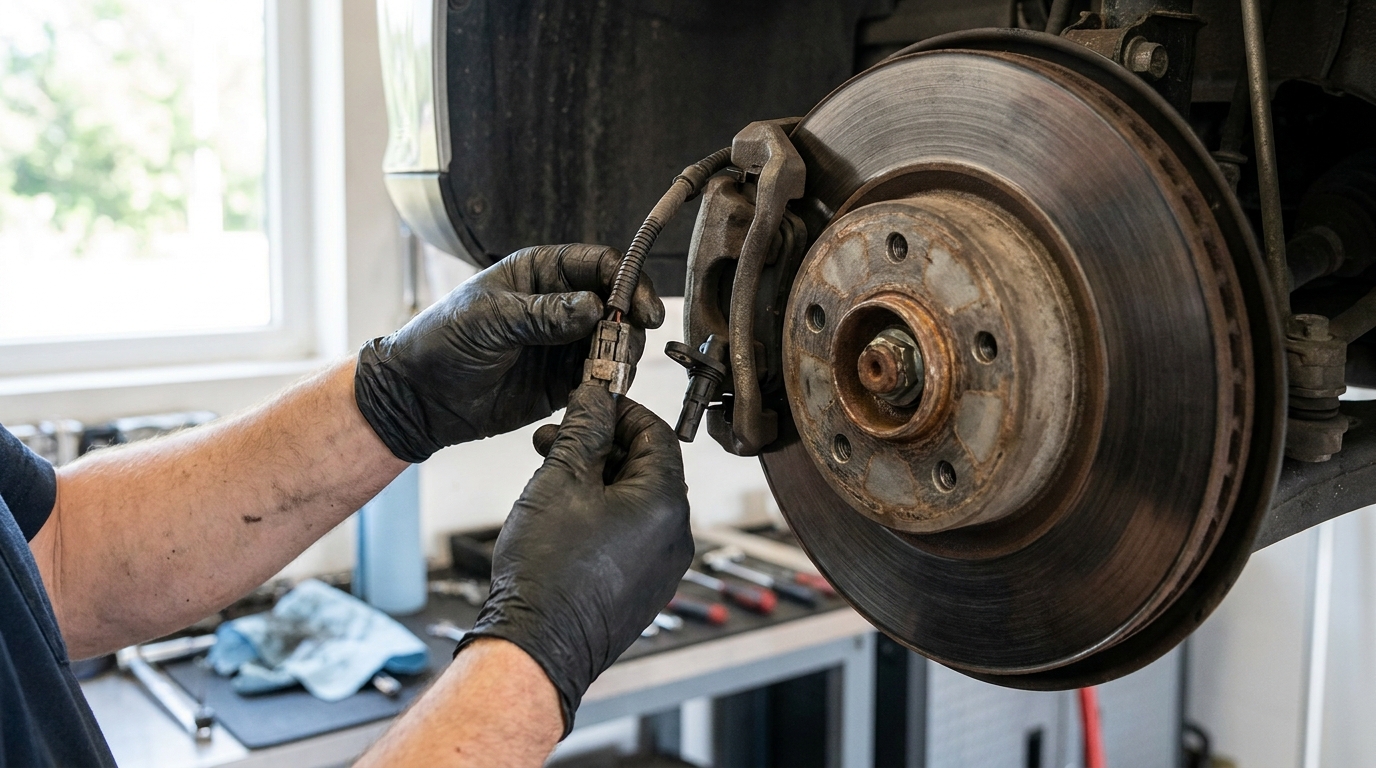
Safely lift the vehicle (or have a shop do it) and inspect the wheel speed sensor and wiring. Look for torn insulation, missing clips, harnesses rubbing on tires, and connectors packed with dirt. Check whether the sensor is physically damaged or pushed out of position.
If the tone ring is visible, inspect for heavy rust, cracks, or missing teeth. On vehicles where the ring is integrated into the hub, you may not see it clearly without disassembly—another reason live data can be helpful.
Practical tip: If the sensor is covered in metal shavings (common with magnetic sensors), carefully clean it. Excess debris can interfere with signal quality. However, if the sensor keeps collecting heavy debris quickly, it may indicate abnormal wear nearby.
Step 4: Check the Basics—Battery, Grounds, and Brake Fluid
Measure battery voltage (or have it tested). A healthy, fully charged battery is typically around 12.6V with the engine off and around 13.7–14.7V with the engine running (varies by vehicle and conditions). Poor grounds can also cause intermittent module faults.
Check brake fluid level and look for any signs of leaks at calipers, brake hoses, and under the master cylinder. If the red brake warning light is on in addition to ABS, treat it as a higher-priority brake system warning.
Actionable advice: If you recently replaced the battery, ensure terminals are tight and clean. A slightly loose terminal can cause momentary voltage drops that trigger ABS faults.
Is It Safe to Drive with the ABS Light On?
Safety depends on what failed and how you drive. In many cases, you can still brake normally in everyday conditions because the base brake system is intact. But without ABS, your risk increases in scenarios where wheel lockup is likely—hard braking, wet roads, snow/ice, gravel, or sudden obstacles.
The key is to separate “the car stops” from “the car stops with maximum control.” ABS is about control and stability under heavy braking. If the ABS light is on, assume ABS is not available until the issue is fixed and confirmed.
Situations Where You Should Avoid Driving (or Drive Only to a Shop)
If you notice any of the following, treat it as urgent and limit driving:
- Red brake warning light is on (not just ABS), especially with a soft pedal or longer stopping distance
- Brake pedal feels spongy, sinks, or requires pumping
- Pulling to one side, grinding noises, or severe vibration
- Brake fluid is low and you can’t explain why
- Multiple electrical warnings suggesting charging issues (battery/alternator)
These symptoms can indicate a problem beyond ABS—potentially affecting core braking. In those cases, it’s safer to stop driving and get the vehicle inspected or towed.
How Driving Changes When ABS Is Disabled
Without ABS, hard braking can lock the wheels. On dry pavement, a skilled driver can sometimes stop quickly without ABS, but steering control is reduced when the tires are sliding. On wet or icy surfaces, locked wheels can dramatically reduce control and increase stopping distance.
Actionable advice: Increase following distance, brake earlier, and avoid sudden inputs. If you must brake hard, use firm, progressive pressure and be prepared for the possibility of wheel lock. (Older advice about “pumping” brakes applies mainly to non-ABS systems; in modern vehicles with ABS disabled, your base brakes are still modern hydraulics—focus on smooth, controlled braking rather than rapid pumping.)
Real example: A driver with an ABS light on approaches a rainy intersection. A car cuts in. The driver slams the brakes, the front wheels lock briefly, and the car skids straight instead of tracking the steering input. With ABS functioning, the driver would likely retain more steering control to avoid the obstacle.
What About Inspection/Emissions and Legal Considerations?
In many regions, an illuminated ABS light can fail a safety inspection. Even if emissions testing doesn’t check ABS, a safety inspection may. If you’re planning a road trip or you’re due for inspection, fixing the ABS light early prevents last-minute surprises.
Also consider insurance and liability: if an ABS-related issue contributes to a crash, it can complicate claims. The safest approach is to diagnose and repair the problem promptly.
Practical Fixes and What Repairs Typically Cost
Repair costs vary widely by vehicle and location, but ABS issues often fall into a few common repair categories. The good news: many ABS light causes are relatively straightforward—especially wheel sensor wiring or a single failed sensor. The bad news: module and hydraulic unit repairs can be costly if misdiagnosed or if parts are scarce.
Below are typical fixes, what’s involved, and how to make sure you’re paying for the right repair.
Wheel Speed Sensor Replacement or Repair
If a sensor is confirmed bad, replacement is often a direct repair. Some sensors are bolt-on and accessible; others are integrated into the wheel bearing/hub assembly. In rust-belt areas, sensors can seize in place, increasing labor time.
Actionable advice: Ask the shop whether the sensor is separate or integrated. If it’s integrated into a hub, replacing only the sensor may not be possible or may not solve tone ring issues. Also ask whether the harness pigtail is available separately if the connector is damaged.
Real example: A scan shows a right front wheel speed sensor fault. The shop checks live data and sees the right front speed drops out over bumps. They find a broken wire near the strut where it flexes. Repairing the wire and securing routing fixes the issue without replacing the sensor.
Tone Ring or Wheel Bearing/Hub Assembly Replacement
If the tone ring is cracked, rust-swollen, or missing teeth, it can cause false readings. On many vehicles, replacing the hub assembly resolves both a failing wheel bearing and the sensor/tone ring signal issue (if integrated).
Actionable advice: If you also hear a humming that changes with speed or when turning, mention it. That clue can point to a wheel bearing/hub problem, which can be related to the ABS signal fault.
Cost note: Hub assemblies can be more expensive than sensors, but they can be the correct fix when the tone ring is part of the hub. Quality matters—low-grade hubs can create repeat comebacks due to poor sensor ring manufacturing tolerances.
Electrical Repairs: Connectors, Grounds, and Fuses
Sometimes the fix is as simple as cleaning and reseating a connector, repairing a chafed harness, or replacing a blown fuse. Grounds are often overlooked: a corroded ground strap can trigger multiple system faults, including ABS.
Actionable advice: If the ABS light appeared after body work, suspension work, or a battery replacement, double-check grounds and connectors in the affected area. It’s common for a connector to be left partially unlatched.
Practical tip: Avoid using cheap “quick splice” connectors for sensor wiring repairs. Proper solder-and-seal or OEM-style crimp-and-seal repairs are more reliable in wet environments.
ABS Module/HCU Repair or Replacement
If diagnostics point to the module or pump motor, you may have options: new OEM, remanufactured, used, or a rebuild service. Some units require coding/programming to match the vehicle, which adds cost and complexity.
Actionable advice: Before approving a module, ask the shop to confirm power and ground integrity, and to document the codes and test results that indicate internal failure. Module replacement based on guesswork is a common and expensive mistake.
Cost note: Module/HCU work can range from moderate to very expensive depending on the vehicle and whether programming is required. A rebuild service can be cost-effective, but turnaround time may matter if it’s your daily driver.
Prevention and Maintenance: Keeping ABS and Brakes Reliable
ABS problems aren’t always preventable—electronics age, corrosion happens, and sensors can fail. But many issues are accelerated by neglected maintenance, harsh environments, or poor-quality parts. A few habits can reduce the likelihood of an ABS warning and improve overall braking performance.
Because Tirestar customers often focus on tire safety, it’s worth emphasizing: tires and ABS work together. ABS can’t create traction—it can only manage braking to use the traction you have. Good tires, correct tire pressure, and even tread depth across the axle make ABS more effective and reduce false triggers.
Keep Tires Matched and Properly Inflated
Significant differences in tire size (including mismatched brands/models with different rolling circumference), uneven tread depth, or incorrect pressure can confuse wheel speed readings—especially on AWD vehicles. While the ABS system can tolerate minor differences, major mismatches can contribute to warnings or stability control issues.
Actionable advice: If you replace one tire due to damage, check whether your vehicle (especially AWD) recommends replacing tires in pairs or all four to keep circumference consistent. At minimum, match size, load rating, and overall diameter as closely as possible.
Practical tip: After rotating tires, if an ABS light appears, don’t assume the rotation “caused” it—but do consider whether a sensor wire was disturbed or whether a pre-existing weak sensor became noticeable under different conditions.
Brake Fluid Service and Brake Inspections
Brake fluid absorbs moisture over time, which can contribute to corrosion in hydraulic components and reduce boiling point. While old fluid doesn’t directly cause most ABS sensor codes, it can affect the ABS hydraulic unit over the long term and increase the risk of internal valve issues.
Actionable advice: Follow your manufacturer’s brake fluid service interval (often every 2–3 years). During brake jobs, ask for a quick inspection of wheel speed sensor wiring and connectors. It’s a small add-on that can catch problems early.
Real example: A driver ignores brake fluid service for years. Eventually, internal corrosion affects the ABS hydraulic unit’s valves. The base brakes still feel okay, but the ABS light comes on with pump/valve codes. A fluid service earlier might have reduced the risk.
Protect Sensors During Tire and Brake Work
Wheel speed sensor harnesses are easy to snag when removing wheels, calipers, or suspension parts. A shop that’s careful with routing and clips prevents future issues. If you do DIY work, take photos of harness routing before disassembly and ensure clips are reinstalled.
Actionable advice: After any brake or suspension service, do a short test drive and verify no warning lights appear. If the ABS light comes on immediately afterward, return to the shop promptly—many issues are simple (a connector not fully seated) and can be corrected quickly.
Practical tip: If you frequently drive on muddy or salted roads, occasional undercarriage rinsing can reduce corrosion at connectors and sensor mounting points—especially after winter storms.
Conclusion: Key Takeaways When the ABS Light Is On but Brakes Feel Normal
An ABS light with normal-feeling brakes usually means your base braking system is still working, but the ABS function has been disabled due to a detected fault. That can lull drivers into a false sense of security—because the difference often only shows up during emergency stops or on slippery roads, when ABS is most valuable.
The most common causes are wheel speed sensor issues, damaged wiring/connectors, tone ring or hub problems, and low-voltage events from a weak battery or charging system. Less commonly, the ABS module or hydraulic unit is at fault. The smartest path is a proper ABS code scan and targeted inspection—rather than guessing and replacing parts.
Until it’s repaired, drive as if you have no ABS: increase following distance, brake earlier, and be cautious in rain, snow, gravel, or any situation that might require hard braking. If the red brake warning light is on, the pedal feels abnormal, or brake fluid is low, treat it as urgent and get the vehicle checked immediately.
Bottom line: The ABS light is a safety warning, not just an annoyance. Addressing it promptly protects your control in emergencies, helps your vehicle pass inspections, and keeps your braking system—and your tires—working together the way they were designed to.