
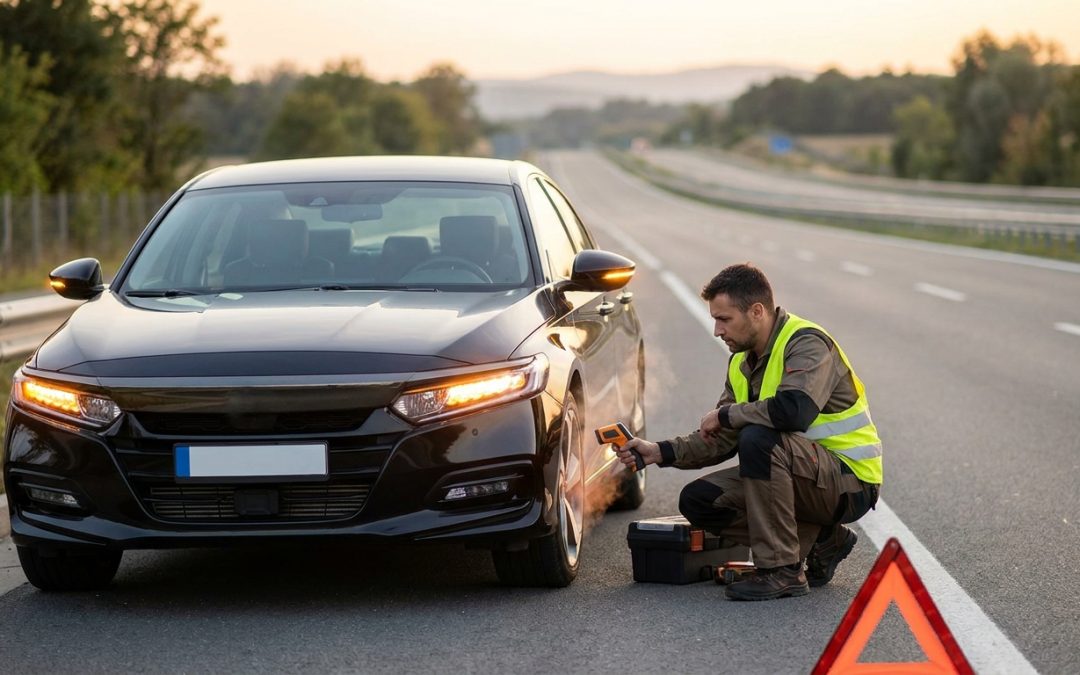
A burning smell coming from one wheel can be unsettling—especially when it shows up after a short drive, a highway exit, or a stop-and-go commute. While odors can come from several sources, a “hot” smell localized to one corner of the vehicle often points to a brake issue that’s creating excess friction and heat. Left unchecked, that heat can damage pads, rotors, wheel bearings, tires, and even brake fluid—turning a manageable repair into a safety hazard.
The good news is that many common causes follow predictable patterns. If you know what to look for (and what not to touch), you can make smarter decisions: whether it’s safe to drive, what to tell a technician, and how to prevent the problem from returning. This guide walks through the brake-related problems most likely to cause a burning smell from one wheel, with practical checks, real-world examples, and actionable next steps.
1) First: Safety checks and what the smell can mean
When one wheel smells like it’s burning, assume that wheel is running hotter than the others. Heat is the clue: something is dragging, binding, or leaking onto a hot surface. Brakes are designed to convert motion into heat, but they’re also designed to release and cool. If a component prevents the brake from fully releasing, heat builds quickly and concentrates at that one wheel.
Different “burning” smells hint at different sources. A sharp, acrid odor can come from overheated brake pads or resin binders in the friction material. A chemical or oily smell may suggest brake fluid or grease contacting hot metal. A rubbery odor can happen if heat from the brakes transfers into the tire sidewall or if a tire is rubbing due to a stuck caliper or misaligned component. You don’t need to identify the exact scent perfectly—just note whether it’s more like “hot brakes,” “burning oil/chemical,” or “burning rubber,” and whether you see smoke.
Before you do anything else, pick a safe place to stop. If you’re on the road and notice pulling to one side, a soft pedal, smoke, or a warning light, reduce speed gradually and avoid hard braking. Find a flat, safe area away from traffic. Once parked, keep your foot off the brake if possible and set the parking brake only if the smell is coming from a front wheel (parking brakes are typically rear—though some vehicles integrate systems differently). If you suspect the rear brakes are overheating, avoid applying the parking brake until you confirm the issue.
Quick “do not” list
Heat-related brake issues can burn you or make the vehicle unstable. Keep these rules in mind:
- Do not touch the wheel, rotor, or caliper—components can exceed several hundred degrees.
- Do not spray water on a hot rotor; rapid cooling can warp or crack it.
- Do not continue driving if you see smoke, feel severe pulling, or the pedal changes dramatically.
- Do not ignore a burning smell that repeats; intermittent dragging often becomes constant.
If you have an infrared thermometer, you can measure wheel or rotor temperatures without contact. A meaningful clue is a large temperature difference side-to-side on the same axle (for example, the left front is 350°F while the right front is 180°F after similar driving). Even without tools, you can often feel heat radiating off one wheel compared to the others—just keep your hands safely away.
2) Sticking brake caliper: the most common one-wheel overheat
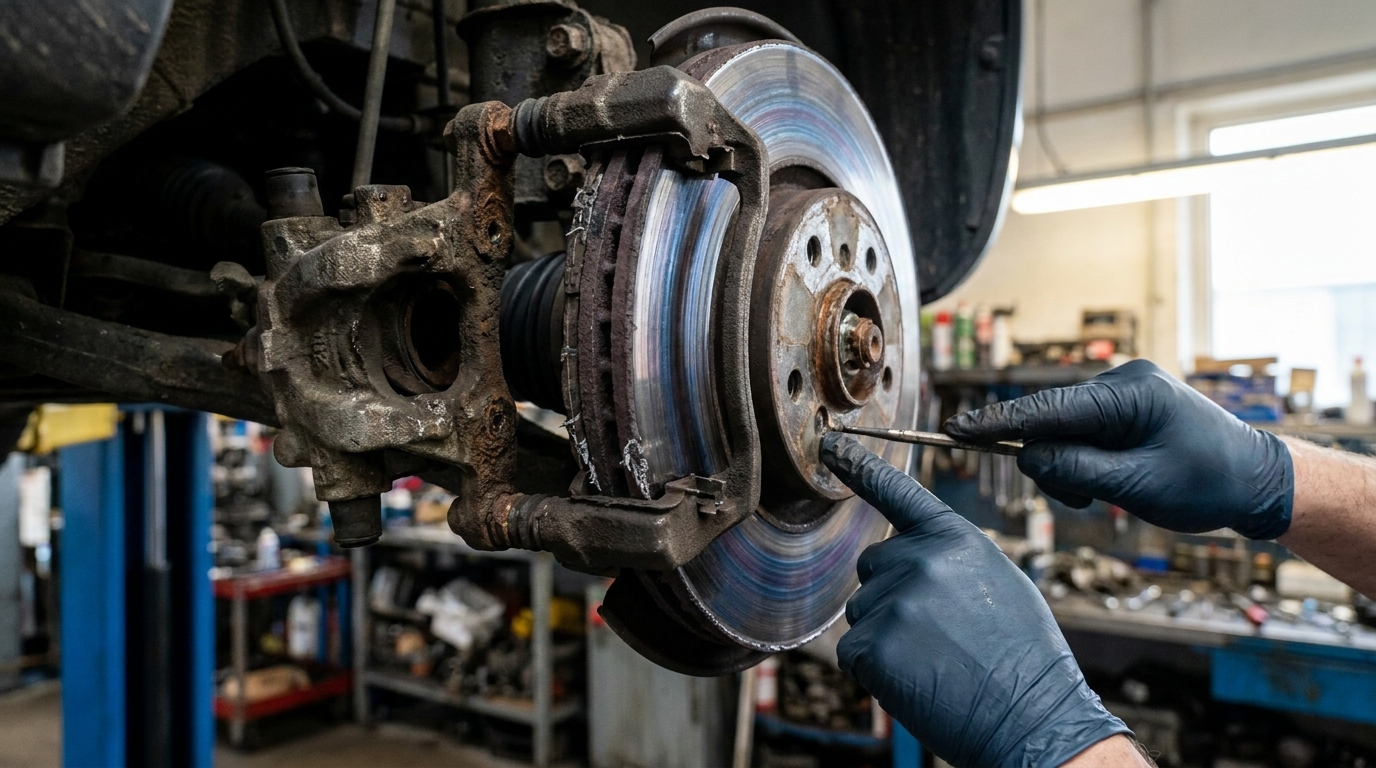
A sticking caliper is one of the most frequent reasons a single wheel smells like it’s burning. Disc brakes rely on the caliper to squeeze the pads against the rotor when you press the pedal, then retract slightly when you release. If the caliper piston sticks or the caliper can’t slide freely on its guide pins, the pads can remain partially clamped to the rotor. That constant contact creates friction, heat, and odor—often strongest after highway driving or long downhill grades.
There are two main “sticking” patterns. First is a stuck piston, commonly caused by corrosion, contaminated brake fluid, or a torn dust boot that allowed moisture in. Second is seized or dry slide pins (also called guide pins), which prevent the caliper from centering and releasing evenly. Both can cause uneven pad wear and a hot wheel, but the feel can differ: a stuck piston may cause stronger pulling and faster overheating, while stuck pins may cause tapered pad wear and intermittent dragging.
Real example: a driver notices a burning smell from the right front wheel after a 20-minute commute. The car also feels slightly sluggish, like it’s “holding back,” and fuel economy drops. At a stop, the right front wheel radiates much more heat than the left. Inspection reveals the outer pad is worn thin while the inner pad looks relatively normal—classic for a caliper that isn’t sliding smoothly on its pins.
Signs to look for at home (without disassembly)
Even without pulling wheels, you can gather useful clues:
- Vehicle pulls to one side while driving or braking (often toward the hot wheel).
- Reduced acceleration or “dragging” sensation, especially after braking.
- One wheel is visibly dirtier (excess brake dust) than the opposite side.
- Heat and smell are strongest after you’ve used the brakes (exits, stoplights, hills).
What fixes it depends on the root cause. Sometimes a caliper can be rebuilt, but many shops replace the caliper assembly for reliability. Slide pins should be cleaned and lubricated with the correct high-temperature brake grease, and the rubber boots replaced if torn. Importantly, pads and rotors on that wheel are often heat-damaged; in many cases, replacing pads and rotors (and often doing both sides of the axle) is the safer long-term solution.
Actionable tip: if one caliper failed due to age and corrosion, the caliper on the opposite side may not be far behind. Many technicians recommend replacing calipers in pairs on the same axle, or at least inspecting the other side closely and servicing the pins on both sides to maintain balanced braking.
3) Collapsed brake hose or hydraulic pressure not releasing
Not all dragging brakes are caused by the caliper itself. A collapsed flexible brake hose can act like a one-way valve: pressure from the brake pedal can reach the caliper and apply the brakes, but the internal hose lining can restrict fluid returning when you release the pedal. The result is a brake that stays applied longer than it should, overheating one wheel and producing a strong burning odor.
This issue is sneaky because it may appear intermittently. The brake might release normally when cold, then start dragging once the hose warms up and the internal damage expands. Drivers often report that the vehicle is fine at the beginning of a trip but begins pulling, smelling hot, or feeling sluggish later. Another clue is that the wheel may be difficult to rotate by hand after driving (if safely lifted and secured), then loosen up after sitting for a while.
Real example: after a brake job, a driver notices the left rear wheel smells hot and the car pulls slightly after 30 minutes of driving. The caliper and pads are new, but the flexible hose is original. A technician finds that cracking the bleeder screw briefly releases trapped pressure and the wheel spins freely—pointing to a restriction upstream, often the hose.
Other hydraulic causes that mimic a stuck brake
While hoses are common, other hydraulic issues can keep pressure in the system:
- Master cylinder problems that don’t fully return fluid (less common for a single wheel, more common for an axle or multiple wheels).
- ABS module faults that hold pressure in a circuit (rare, but possible).
- Incorrect brake pedal free play or adjustments that prevent full release (vehicle-dependent).
Because hydraulic diagnosis can require pressure gauges and scan tools, the most actionable step for a driver is documentation. Note when the smell occurs (time/distance into trip), whether it worsens with repeated braking, and whether the wheel frees up after the car sits. That timeline helps a shop reproduce the fault and avoid replacing parts unnecessarily.
Actionable tip: if a shop replaces a caliper due to dragging, ask them to evaluate the hose condition as well—especially on older vehicles or in rust-prone climates. Replacing a marginal hose can prevent a repeat failure and protect the new caliper from overheating.
4) Seized slide pins, pad hardware issues, and “new brake” mistakes
Brake hardware is easy to underestimate. Modern disc brakes depend on small components—abutment clips, pad shims, anti-rattle springs, and guide pins—to let the pads move smoothly and retract properly. If those pieces are corroded, installed incorrectly, or missing, pads can bind in the bracket and stay in contact with the rotor. That can generate a burning smell from one wheel even if the caliper piston is healthy.
Slide pins deserve special attention. They must be clean, straight, and lubricated with the correct product. Using the wrong grease (or too much) can swell rubber boots or attract debris. If a pin is seized, the caliper can’t float, leading to uneven pad contact and overheating. In areas with road salt, pins can corrode to the point that the caliper effectively becomes fixed in place.
Pad binding in the bracket is another frequent issue. Rust builds up under stainless abutment clips, narrowing the space where the pad “ears” slide. After a brake job, if the bracket wasn’t cleaned and the hardware wasn’t replaced, the new pads may fit too tightly. The brakes can feel fine initially, but after heat expansion, the pads can stick and drag—creating that one-wheel hot smell.
Common installation-related causes (and how to avoid them)
If the burning smell started soon after brake service, consider these possibilities:
- Pad clips/hardware reused when they should have been replaced.
- Bracket not cleaned (rust not removed under clips).
- Wrong pads (slightly incorrect shape can bind).
- Caliper piston not fully retracted or retracted improperly, causing constant contact.
- Parking brake mechanism not reset correctly on rear calipers with integrated parking brakes.
Real example: a customer gets rear pads and rotors replaced. Two days later, there’s a burning smell from the left rear and the wheel is noticeably hotter. The shop finds the pad abutment clips were not seated correctly, causing the inner pad to wedge. Once corrected and the bracket cleaned, the dragging stops—before the new rotor is permanently heat-spotted.
Actionable tip: after any brake job, do a cautious break-in (bedding) procedure if recommended by the pad manufacturer. Proper bedding helps transfer an even layer of pad material to the rotor and reduces the chance of hot spots and odors. If you smell burning during gentle driving days after a brake job—especially if it’s only one wheel—treat it as a potential installation or hardware issue, not “normal break-in.”
5) Parking brake dragging (especially rear wheels)
A burning smell from one rear wheel is often tied to a parking brake that isn’t fully releasing. Depending on the vehicle, the parking brake may use a cable that actuates a lever on the rear caliper (common on many cars), or a small set of drum shoes inside the rear rotor “hat” (common on trucks and some SUVs). If a cable is corroded, misadjusted, or partially seized, it can keep one side applied.
Dragging parking brakes can be subtle because you may not feel it immediately. You might notice the vehicle feels underpowered, the rear wheel smells hot after a drive, or the rear brakes wear out faster than expected. In some cases, the parking brake warning light isn’t triggered because the lever inside the cabin is fully down even though the cable at the wheel is sticking.
Real example: after a rainy week, a driver smells burning from the right rear wheel on the first drive of the day. The issue fades after a few miles but returns the next morning. The cause is a parking brake cable with moisture intrusion and corrosion; it releases slowly, leaving the shoe or caliper lever partially applied until heat and vibration free it up.
How to recognize parking brake drag
Parking brake-related overheating often shows these patterns:
- Smell comes from the rear and may be stronger after using the parking brake on an incline.
- Problem is worse after rain/snow or after the car sits.
- One rear wheel is much hotter than the other after a short drive.
- Rear brake dust or discoloration appears concentrated on one side.
Fixes range from cleaning and lubricating the cable ends to replacing cables, hardware, or the parking brake shoes. If your vehicle uses drum-in-hat parking brakes, broken return springs or delaminated shoe linings can also cause dragging and burning smells. Because these components are hidden, the first visible sign may be odor and heat.
Actionable tip: if you rarely use your parking brake, the mechanism can seize from lack of movement. Using it regularly (where safe and appropriate) can help keep cables and levers moving—though if you already suspect dragging, avoid repeated use until it’s inspected to prevent overheating.
6) Heat damage, warning signs, and when to stop driving
Once a brake has overheated at one wheel, secondary damage becomes a real concern. Excessive heat can glaze pads (reducing friction), create rotor hot spots (leading to pulsation), boil brake fluid (causing a soft pedal), and cook nearby components like wheel bearings and grease seals. In extreme cases, heat can weaken the tire and raise the risk of a blowout—especially if the smell is accompanied by a rubber odor and the sidewall is getting heat-soaked.
One of the most important skills is knowing when the situation is no longer “drive it to the shop carefully.” If the smell is strong and persistent, if you see smoke, or if the car is pulling hard, continuing to drive can turn a stuck brake into a fire risk. Brake components can reach temperatures high enough to ignite grease or melt nearby plastic parts. While vehicle fires are still relatively rare, the conditions that cause them—continuous friction and trapped heat—are exactly what a dragging brake creates.
Real example: a driver smells burning at a front wheel but continues on the highway. Ten miles later, the steering wheel shakes under braking and the pedal feels inconsistent. The rotor is heat-checked and the pads are glazed; the caliper piston seal has been damaged by heat. What might have been a caliper-and-pads repair becomes a caliper, pads, rotor, and fluid flush—plus a risk to the wheel bearing.
Practical steps you can take right now
If you suspect a brake problem at one wheel, these steps help you stay safe and reduce damage:
- Stop and let it cool in a safe area. Give it 30–60 minutes if the smell is strong.
- Look for smoke, fluid drips, or discoloration on the wheel (blueing can indicate high heat).
- Compare wheel heat side-to-side without touching—use an infrared thermometer if available.
- Avoid the highway if you must drive; choose a shorter, lower-speed route to a shop.
- Tell the shop specifics: which wheel, when it happens, whether it pulls, and whether it started after brake service.
At the repair shop, expect a thorough inspection that may include: checking pad wear patterns, caliper slide function, piston retraction, hose condition, parking brake operation, rotor condition (hot spots/cracks), and a brake fluid check (moisture content and signs of boiling). If overheating occurred, a brake fluid flush is often recommended because overheated fluid can degrade and absorb moisture, lowering its boiling point and increasing the risk of fade later.
Actionable tip: ask for the old parts back or ask the technician to show you the wear pattern. Uneven pad wear tells a story—inner vs. outer pad differences often point to piston vs. slide problems, and heavily worn rear pads on one side can point to parking brake or cable issues. Understanding that story helps you confirm the root cause was addressed, not just the symptoms.
Conclusion: Treat a one-wheel burning smell as a brake warning
A burning smell from one wheel is rarely “nothing.” In many cases, it’s your earliest warning that a brake is dragging—most commonly from a sticking caliper, seized slide pins, binding pad hardware, a collapsed brake hose, or a parking brake that isn’t fully releasing. Because the problem concentrates heat at a single corner, damage can spread quickly to pads, rotors, brake fluid, wheel bearings, and even the tire.
The smartest response is to prioritize safety, confirm the issue is localized to one wheel, and avoid continued driving if you see smoke, feel strong pulling, or notice a changing brake pedal. Provide clear observations to your technician—when it happens, which wheel, and whether it began after service—so they can pinpoint the real cause instead of guessing.
Key takeaways: heat is the clue, dragging is the usual mechanism, and early inspection saves money and reduces risk. If you catch a dragging brake early, the fix may be as simple as servicing hardware or replacing a hose. If you ignore it, you can end up replacing major components—and compromising your ability to stop safely when it matters most.