

Most drivers don’t think about the fuel filter until the car starts acting “off”—a stumble here, a hard start there, or a sudden loss of power that feels like the engine is running out of breath. Because a fuel filter is out of sight and usually quiet when it’s doing its job, it’s easy to miss the early warning signs. But when it becomes clogged, it can restrict fuel flow, strain your fuel pump, and cause issues that range from annoying to dangerous—especially if the vehicle hesitates while merging or climbing a hill.
A clogged fuel filter is one of those problems that can mimic other issues, like worn spark plugs, a failing ignition coil, a dirty mass airflow sensor, or even transmission trouble. That’s why recognizing the most common symptoms—and understanding what’s happening mechanically—can help you diagnose the problem sooner, avoid unnecessary repairs, and keep your vehicle reliable. In this guide, we’ll break down five clear symptoms your car may have a clogged fuel filter, plus practical checks, real-world examples, and what to do next.
While fuel filters vary by vehicle (some are in the engine bay, some are along the frame rail, and many modern cars use an in-tank filter integrated with the fuel pump module), the principle is the same: the filter traps contaminants before they reach the injectors. Over time, trapped debris reduces fuel pressure and volume—especially under load—leading to performance and drivability issues.
How a Fuel Filter Gets Clogged (and Why It Matters)
Your fuel system is designed to deliver a precise amount of fuel at a specific pressure. The fuel pump sends fuel from the tank to the engine, and the filter sits in the middle as a gatekeeper. It catches rust flakes, dirt, sediment, and other contaminants that can accumulate from aging tanks, poor-quality fuel, or water intrusion. Even with good fuel, tiny particles add up over thousands of miles.
When the filter begins to clog, fuel flow is restricted. At idle, your engine may still run fairly normally because fuel demand is low. But as soon as you accelerate, climb a hill, tow a trailer, or run the air conditioning on a hot day, fuel demand increases—and the restricted filter can’t keep up. The result is often intermittent symptoms that come and go, which can make the problem tricky to pinpoint.
A clogged filter also forces the fuel pump to work harder. The pump must push against higher resistance to maintain pressure. Over time, that extra strain can shorten pump life. Fuel pumps are typically far more expensive and labor-intensive to replace than a filter, so catching a clog early can save significant money.
It’s also worth noting that modern fuel injection systems are sensitive. Injectors have very small passages and are calibrated to deliver fuel in fine sprays. Contamination or low pressure can disrupt spray patterns, causing misfires, poor combustion, and higher emissions. In other words, the fuel filter isn’t just a “maintenance item”—it protects expensive components and helps the engine run efficiently.
Common Causes of Fuel Filter Restrictions
Clogging doesn’t always mean “dirty fuel.” Several real-world situations can accelerate filter blockage:
- High-mileage vehicles with original filters that have never been replaced.
- Rust or sediment in the fuel tank, especially in older vehicles or those that sit for long periods.
- Water contamination from condensation or compromised fuel storage, which can carry debris and promote corrosion.
- Frequent low-fuel driving, which can stir up sediment near the bottom of the tank.
- Aftermarket or questionable fuel sources that may contain more particulates.
With that foundation, let’s get into the five symptoms that most often point to a clogged fuel filter.
Symptom #1: Hard Starting or Extended Cranking
One of the earliest signs of a restricted fuel filter is a car that takes longer to start than it used to. You turn the key (or press the start button), and the engine cranks for several seconds before firing. In more severe cases, it may start and then immediately sputter, forcing you to try again. This happens because the engine isn’t getting fuel at the right pressure quickly enough during startup.
During a cold start, fuel demand spikes briefly as the engine management system enriches the mixture to stabilize idle. If the filter is restricting flow, fuel pressure may build slowly, delaying ignition. On some vehicles, you may notice that cycling the key to “ON” for a few seconds before cranking helps—because it gives the pump extra time to build pressure. That “workaround” is a strong clue that fuel delivery is marginal.
A real example: a driver might report, “It starts fine in the afternoon, but in the morning it cranks longer.” That pattern can occur because overnight, fuel pressure bleeds down, and the system needs to rebuild pressure from scratch. A partially clogged filter makes that rebuild slower and less consistent.
Hard starting can also be caused by a weak battery, failing starter, bad fuel pump, leaking injector, or faulty crank sensor. The key difference is that fuel-filter-related hard starts often come with other fuel starvation symptoms—like hesitation under load or stalling—especially as the clog worsens.
Actionable Checks You Can Try
- Listen for the fuel pump prime: With the key in “ON,” you should often hear a brief hum from the rear of the vehicle. If it sounds unusually loud or strained, the pump may be working too hard.
- Try the key-cycle test: Turn the key to “ON” for 3–5 seconds, then off, then on again, and then start. If this noticeably improves starting, fuel pressure may be slow to build.
- Scan for codes: Even if the check engine light is off, a scan tool may show pending lean-condition or misfire codes that support a fuel delivery issue.
If hard starting is becoming more frequent, it’s smart to address it early. Replacing a filter is often inexpensive compared with the damage caused by prolonged low fuel pressure.
Symptom #2: Hesitation, Surging, or Jerking Under Acceleration
Hesitation under acceleration is one of the most classic symptoms of a clogged fuel filter. You press the gas, and instead of smooth power, the car pauses, stumbles, or feels like it “catches” and then goes. This is especially noticeable when merging onto a highway, passing another vehicle, or accelerating up an incline—times when the engine needs a steady, higher volume of fuel.
As the filter restricts flow, the fuel rail may not maintain the pressure the injectors need. The engine runs lean (too much air, not enough fuel), and combustion becomes unstable. The vehicle may surge—briefly gaining power, then losing it—because the system is constantly trying to correct fueling based on sensor feedback. In some cases, it can feel like a transmission issue because the car lurches or bucks, but the root cause is inconsistent fuel delivery.
A practical example: you may notice the car drives normally at steady speeds, but the moment you demand more power—like accelerating from 30 to 50 mph—it hesitates. That’s because cruising requires relatively little fuel. The problem shows up when demand exceeds what the clogged filter can supply.
This symptom can also be linked to dirty injectors, a failing ignition system, or a bad throttle body. However, if the hesitation is most pronounced under load and improves when you ease off the throttle, fuel restriction moves higher on the suspect list.
Tips to Confirm It’s Fuel-Related
- Note when it happens: If hesitation is worst during hard acceleration, towing, or uphill driving, think fuel delivery.
- Pay attention to consistency: Fuel filter restriction often starts intermittently and becomes more frequent over time.
- Look for lean symptoms: A rough, “thin” sounding engine under load and higher-than-normal engine temperature can point to lean running.
If the car hesitates in traffic or while merging, treat it as a safety issue. Even if it “clears up,” the underlying restriction typically continues to worsen.
Symptom #3: Engine Misfires, Rough Idle, or Poor Throttle Response
When fuel delivery is inconsistent, one or more cylinders may not receive the correct fuel amount at the right time. That can lead to misfires—small interruptions in combustion that you may feel as a vibration, a shudder, or an uneven engine note. Sometimes the check engine light will flash during a severe misfire, indicating potential catalytic converter damage.
A clogged fuel filter can cause rough idle because the engine is operating at the edge of stable combustion. At idle, fuel demand is low, but the engine still needs a consistent mixture. If fuel pressure fluctuates due to restriction, the ECU may constantly adjust injector pulse width to compensate. Those rapid corrections can feel like a rough or “hunting” idle, where RPM rises and falls slightly.
Poor throttle response is another related clue. You may press the pedal and feel a delay before the engine responds, or the engine may feel weak and unwilling. This is different from the obvious hesitation under hard acceleration; it can show up even with light throttle inputs, especially as the clog becomes severe.
Because misfires and rough idle have many possible causes—spark plugs, coils, vacuum leaks, PCV issues, dirty injectors—it’s important to look for patterns. If the roughness gets worse under load or at higher RPM, and especially if it appeared gradually over time, fuel restriction becomes a strong possibility.
What to Watch For (Real-World Clues)
- Misfire codes (P0300–P0306) paired with lean codes (P0171/P0174) can point toward fuel starvation.
- Rough idle after refueling can sometimes suggest stirred-up sediment temporarily worsening an already restricted filter.
- Improvement at very light throttle but worsening when you demand power often indicates the system can’t meet higher fuel volume needs.
If you’re troubleshooting at home, avoid “parts swapping” based on guesswork. A basic diagnostic approach—scanning codes, checking fuel trims, and measuring fuel pressure—can save time and money.
Symptom #4: Stalling, Especially at Low Speeds or When Idling
Stalling can be one of the more alarming symptoms of a clogged fuel filter, and it often shows up after the restriction becomes significant. You may come to a stoplight and the engine dies, or the car may stall while turning into a parking lot. In some situations, it might restart right away; in others, it may crank longer than usual before it fires.
Why low speeds? At idle and low-speed maneuvering, the engine is sensitive to small changes in airflow and fuel delivery. If the fuel filter is heavily restricted, the fuel pressure may drop below the minimum required to maintain stable combustion when the ECU reduces throttle opening or when the load changes (like power steering load during a turn or A/C compressor cycling on).
Stalling can also occur after a period of driving at speed. A partially clogged filter may allow enough fuel for cruising, but after sustained demand, pressure and flow can fall off. When you then slow down, the system may not recover quickly enough to stabilize idle, and the engine stalls.
Because stalling has many potential causes—dirty throttle body, failing crankshaft position sensor, vacuum leaks, EGR issues—it’s important to consider the full symptom set. If stalling is paired with hesitation, hard starts, and general loss of power, a clogged fuel filter is a prime suspect.
Safety-Focused Advice
- Don’t ignore repeated stalls: If your vehicle stalls in intersections or during turns, schedule service promptly.
- Document conditions: Note fuel level, outside temperature, whether A/C was on, and whether it happened after highway driving—details help diagnosis.
- Avoid “quick fixes”: Fuel additives rarely solve a physically clogged filter. They may help minor injector deposits, but they won’t remove trapped debris from a filter element.
If the car stalls and won’t restart, avoid repeatedly cranking for long periods. Excessive cranking can overheat the starter and drain the battery, complicating diagnosis and recovery.
Symptom #5: Loss of Power at High Speed, Uphill, or Under Load
A clogged fuel filter often reveals itself most clearly when the engine needs sustained fuel flow—highway speeds, long hills, towing, or carrying heavy loads. You may feel the car struggle to maintain speed, especially on inclines, or you may notice that it tops out earlier than it used to when accelerating. In severe cases, the vehicle may enter a reduced-power mode as the ECU detects abnormal conditions.
This symptom is essentially fuel starvation at scale. At higher RPM and load, injectors must deliver more fuel, and the pump must maintain pressure. If the filter is restricted, pressure can drop as demand rises. The engine runs lean, power falls off, and exhaust gas temperatures can increase. Over time, this can stress the catalytic converter and other components.
A realistic scenario: you’re driving on the highway and everything seems fine until you hit a long grade. Halfway up, the car starts to feel like it’s “running out of gas,” even though the tank isn’t empty. You press the pedal more, but the engine doesn’t respond proportionally. If you back off, the car stabilizes. That pattern strongly suggests the fuel system can’t keep up with demand.
Loss of power under load can be misdiagnosed as a transmission that won’t downshift or an engine that’s “just tired.” But if the issue appeared gradually and is worse during sustained power demand, fuel restriction should be tested.
Action Steps to Protect Your Engine
- Avoid heavy load driving (towing, steep hills) until the issue is diagnosed, especially if the engine is running lean.
- Check maintenance history: If the fuel filter interval has been missed (or never done), it’s a logical first step.
- Ask for a fuel pressure and volume test: Pressure alone can sometimes look “okay” at idle; volume testing under load can reveal restriction.
Replacing a clogged filter can restore power immediately if the filter is the root cause. If power doesn’t return, the restriction may be elsewhere (pump, tank sock/strainer, lines) or there may be an additional issue that the clogged filter was masking.
What to Do Next: Diagnosis, Replacement, and Prevention
If you suspect a clogged fuel filter, the best next step is a structured diagnosis—not guesswork. Many modern vehicles don’t have a simple, serviceable inline filter; instead, the filter may be part of the in-tank fuel pump module. That doesn’t change the symptom set, but it does affect cost and labor. Knowing your vehicle’s design (serviceable filter vs. integrated module) helps set expectations.
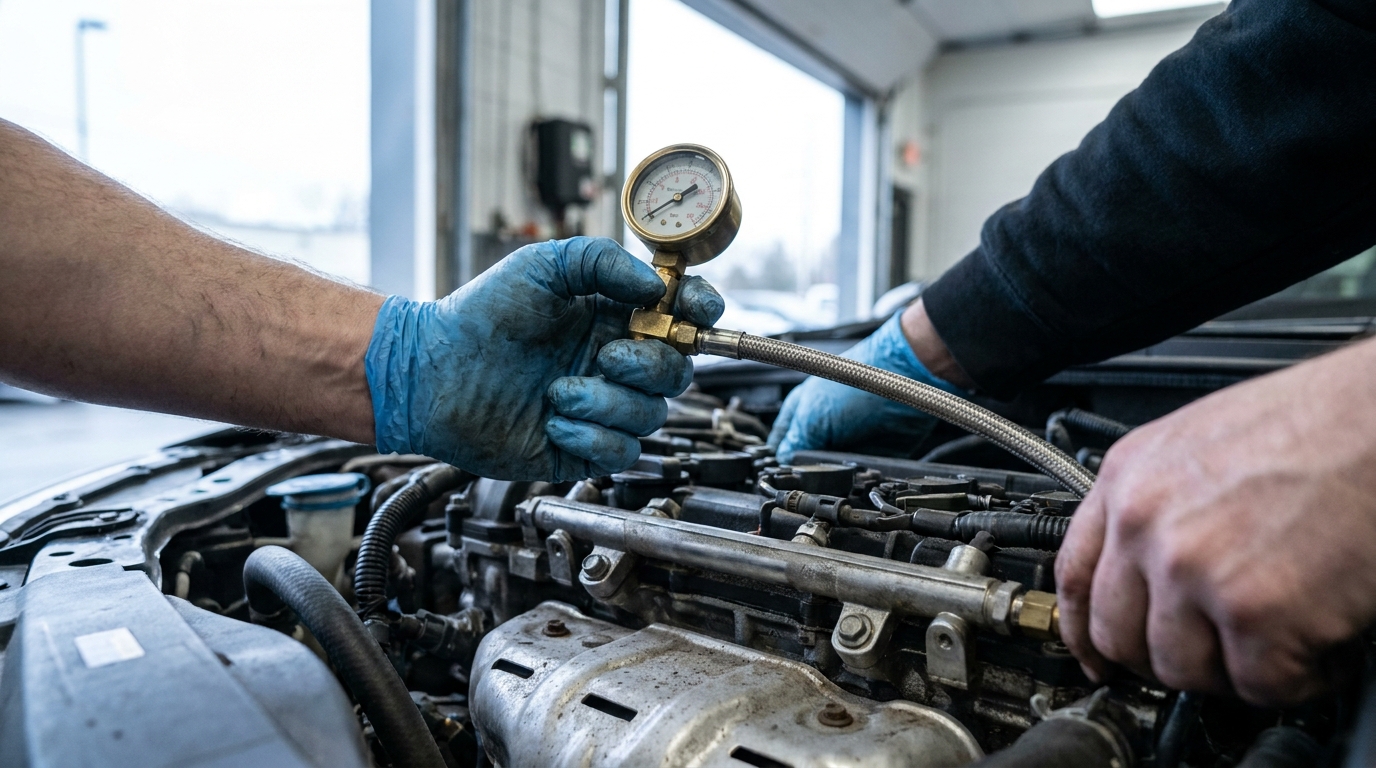
A professional shop will typically start by scanning for diagnostic trouble codes, reviewing fuel trim data, and checking fuel pressure. In some cases, they’ll test pressure under load or perform a fuel volume test. A restricted filter may show normal pressure at idle but fail to maintain pressure during acceleration. If the filter is serviceable, replacement is often a straightforward job; if it’s in-tank, the technician may recommend replacing the pump module or a filter element within it, depending on the design.
For DIY-minded drivers, replacing an external filter can be manageable, but safety is critical. Fuel systems are pressurized, gasoline is highly flammable, and spills can be dangerous. Always relieve fuel pressure properly, work in a well-ventilated area away from ignition sources, and use the correct replacement part. If you’re not confident, it’s worth having a professional handle it—especially on systems that require special tools or procedures.
Prevention comes down to maintenance and fuel habits. Follow your manufacturer’s service schedule, and if you don’t know when the filter was last replaced, consider it a baseline maintenance item—particularly on higher-mileage vehicles. Also, avoid running the tank very low regularly. While modern systems are designed to handle normal use, consistently driving near empty can increase the likelihood of pulling sediment into the system and can also reduce fuel pump cooling.
Practical Prevention Tips
- Replace the filter at recommended intervals (or earlier if you drive in dusty conditions or have a high-mileage vehicle).
- Use reputable fuel stations with high turnover to reduce contamination risk.
- Address a rusty or contaminated tank: If the tank is shedding rust, repeated filter clogs may occur until the source is fixed.
- Don’t rely on additives as a substitute for maintenance; they can help with minor deposits but won’t unclog a filter element.
- Pair filter service with a general inspection: If a filter was clogged, it’s wise to check pump health and injector performance.
Finally, remember that drivability issues rarely improve on their own. A fuel filter typically becomes more restricted over time, and the longer you wait, the more likely you are to damage the fuel pump or create secondary problems from lean operation.
Conclusion: Key Takeaways on Clogged Fuel Filter Symptoms
A clogged fuel filter can start as a minor annoyance and gradually turn into a major drivability and safety concern. The five most common symptoms to watch for are: hard starting or extended cranking, hesitation or surging under acceleration, misfires and rough idle, stalling at low speeds or idle, and loss of power at high speed or under load. These issues often appear intermittently at first, then become more frequent as restriction increases.
The smartest approach is early diagnosis and timely maintenance. If your vehicle has a serviceable filter and it’s overdue, replacing it can be a cost-effective fix that restores performance quickly. If the filter is integrated into the pump module, proper testing becomes even more important to avoid replacing the wrong component. Either way, confirming fuel pressure and—when possible—fuel volume under load is the most reliable way to identify restriction.
Above all, treat fuel delivery symptoms as more than just “a nuisance.” Smooth acceleration, stable idle, and consistent power aren’t just comfort features—they’re part of safe, predictable driving. If you’re noticing these warning signs, schedule an inspection and get ahead of the problem before it leaves you stranded or leads to more expensive repairs.