

Few things feel more unsettling than a car that won’t track straight at highway speeds. You set the wheel where you want it, yet the vehicle slowly pulls left or right, or it “wanders” as if it’s constantly searching for a lane position. Beyond being annoying, drifting or wandering can be a safety issue—especially in crosswinds, on grooved pavement, or in heavy traffic where precise control matters.
The good news is that most highway drift problems are diagnosable and fixable. The tricky part is that the symptoms can look similar even when the root causes differ: tires, alignment, worn steering or suspension parts, brake drag, or even road conditions. This guide breaks down the most common reasons your car drifts or wanders on the highway, how to recognize each one, and what you can do—today—to improve stability and confidence behind the wheel.
1) Drifting vs. wandering: what you’re really feeling
Drivers often use “pull,” “drift,” and “wander” interchangeably, but they can point to different issues. A pull is a consistent tendency to move to one side even on a flat, straight road. A drift is a gentler version—your car slowly migrates left or right and you keep correcting. Wandering is different: the car doesn’t necessarily favor one side, but it feels loose or twitchy, requiring frequent small steering inputs to stay centered.
Before you spend money on parts, it helps to do a quick “symptom check” in a safe environment. On a calm day, on a straight road with light traffic, note whether the issue is directional (always left, always right) or variable (changes with wind, road surface, or speed). Also pay attention to whether it’s worse while accelerating, braking, or cruising. Those clues narrow the list of likely causes.
Also remember that roads are built with crown (a slight slope) to drain water. Many vehicles will naturally drift a little to the right on crowned roads. A mild right drift that disappears on flatter pavement may be normal. A strong pull that requires constant counter-steer is not.
Quick self-test: isolate the pattern
Try these simple checks (safely, without taking your eyes off the road for long):
- Speed sensitivity: If it’s mostly at 60–75 mph, tires, balance, alignment, or worn steering components are common suspects.
- Road sensitivity: If it’s worse on grooved concrete or rutted asphalt, you may be experiencing tire tramlining (tread following the grooves).
- Brake sensitivity: If it pulls during braking, think brake caliper drag, uneven pad wear, or suspension bushings.
- Direction consistency: A consistent pull can indicate alignment, tire conicity, or brake drag on one side.
Write down what you notice. Even a short note like “pulls left only when braking” or “wanders on grooved highway” helps a technician diagnose faster—and helps you avoid replacing the wrong parts.
2) Tire-related causes: pressure, wear, and “tramlining”
Tires are the most common and most overlooked cause of highway drift. They’re the only contact with the road, and small differences between left and right tires can steer the car without you realizing it. Even when tread looks “fine,” issues like uneven wear, mismatched tires, or incorrect pressure can make a vehicle feel unstable at speed.
Start with tire pressure. A few PSI difference side-to-side can cause a pull or a vague, wandering feel—especially on lighter vehicles. Pressure also changes with temperature, so the first cold morning after a heat wave can reveal a problem that wasn’t obvious the day before. Always check pressure cold, and set it to the vehicle’s door-jamb placard spec (not the tire sidewall maximum).
Next is tread wear. Cupping (scalloped dips), feathering (sawtooth edges), or inside-edge wear can create wandering and poor straight-line stability. These wear patterns often indicate alignment or worn suspension parts, but the tire wear itself can continue to cause drift even after the underlying issue is corrected—meaning you may need an alignment and tire replacement to fully fix the feel.
Mismatched tires and tire “conicity” (a sneaky pull)
Mixing tire brands, models, or even different tread patterns left-to-right can cause a car to track unevenly. Tires are complex structures; two tires of the same size can have different stiffness and “self-steering” characteristics. One common phenomenon is tire conicity, where a tire behaves like a cone and naturally rolls to one side, creating a pull.
A practical example: you replace one front tire after a puncture, but keep the other older tire. The car suddenly drifts toward the side with the newer tire (or away from it). This can happen even if pressures are correct and alignment is within spec. A simple diagnostic step is a tire cross-rotation: swap the front tires left-to-right. If the pull direction changes, the tires are likely involved.
Actionable tip: if you must replace only one tire, match the exact brand/model and similar tread depth when possible. For many vehicles, replacing in pairs on the same axle provides more stable handling and more predictable braking.
Tramlining: when the road “steers” your tires
If your car feels like it’s being tugged by grooves or ruts—especially on concrete highways—your tires may be tramlining. Wider tires, aggressive tread patterns, and certain performance-oriented designs can be more sensitive to road texture. Low-profile tires can also transmit more of this effect into the steering wheel.
What you can do: verify pressures, inspect for uneven wear, and consider a tire with a more highway-friendly tread pattern if you’re due for replacement. If you recently changed wheels/tires and the wandering started immediately, that’s a strong clue the new setup is more prone to tramlining. A reputable tire shop can recommend models known for straight-line stability and lower sensitivity to grooves.
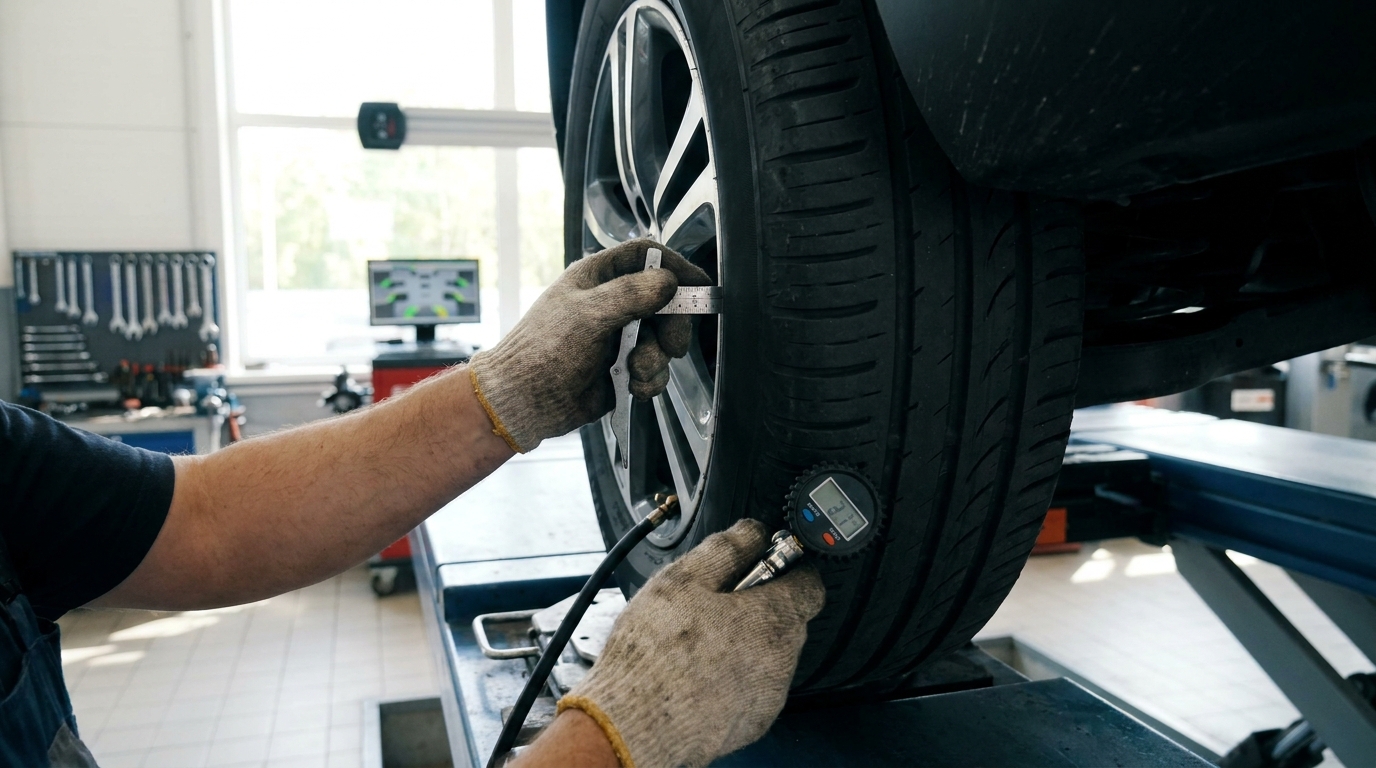
3) Wheel alignment issues: toe, camber, caster, and road crown
Alignment is a major contributor to highway tracking. The three primary angles—toe, camber, and caster—work together to keep your car stable and predictable. When one angle is out of spec, the vehicle may pull, drift, or feel nervous and “darty” at speed.
Toe (the direction the tires point relative to the centerline) is especially important for straight-line stability. Too much toe-in or toe-out can make the car wander and can rapidly wear tires. Toe can change over time from impacts (potholes, curbs), worn tie rod ends, or even after suspension work if alignment wasn’t performed.
Camber is the inward or outward tilt of the wheel. Uneven camber side-to-side can cause a pull, and excessive negative camber can wear the inner edges of tires, which then contributes to instability. Caster is the forward/back tilt of the steering axis; it’s a key factor in steering “self-centering.” Too little caster or a mismatch side-to-side can make the steering feel light and prone to wandering.
Why “within spec” isn’t always ideal
Alignment specs often include a range. A vehicle can be “green” on the printout yet still drift if the settings are at opposite ends of the acceptable window. Cross-caster and cross-camber (differences between left and right) matter a lot for pull. A skilled alignment technician can adjust settings to balance road crown and improve highway tracking rather than simply aiming for the middle of the range.
Real-world example: a driver complains of a mild right drift. The alignment sheet shows everything within spec, but front caster is slightly lower on the right than the left. Even a small cross-caster difference can encourage the vehicle to drift. Correcting that imbalance often improves straight-line stability immediately.
Actionable tip: ask for the before-and-after alignment printout, and ask the shop to evaluate cross-caster/cross-camber and toe symmetry. If the car still drifts after alignment, request a road test with the technician—sometimes the issue is tire-related or component wear that prevents the alignment from “holding.”
Signs you should schedule an alignment now
- Steering wheel is off-center when driving straight
- Uneven tire wear (inside edge, feathering, cupping)
- Car pulls to one side on a flat road
- You hit a significant pothole or curb recently
- You replaced suspension or steering components
Alignment is not just about tire life—it’s about stability. If you’re constantly correcting the wheel on the highway, you’re also increasing fatigue and reducing your margin for emergency maneuvers.
4) Worn steering and suspension components: looseness you can’t “align out”
Even the best alignment can’t compensate for worn parts. If components have play, the wheels can change direction slightly as loads shift—creating a wandering feeling that’s most noticeable at highway speeds. This is especially common on higher-mileage vehicles, trucks, and SUVs that see rough roads.
Common culprits include tie rod ends (inner or outer), ball joints, control arm bushings, steering rack bushings, and wheel bearings. When these parts wear, the suspension can move in unintended ways. You might feel it as a delayed response to steering input, a need to “chase” the lane, or a slight clunk over bumps.
Shocks and struts also play a huge role in stability. Worn dampers can allow the car to float, bounce, or feel unsettled after dips in the road. While shocks don’t set alignment angles directly, they control tire contact with the road. Poor contact equals reduced directional control—especially in crosswinds or on uneven pavement.
How wandering shows up with worn parts
Worn steering/suspension issues often present as “it doesn’t feel planted.” You may notice:
- Small steering corrections that don’t immediately change direction
- The car reacts differently depending on throttle or braking
- Instability over expansion joints or bridge seams
- Steering wheel that doesn’t return to center smoothly
Real example: a vehicle tracks fine at 45 mph but wanders at 70 mph and feels worse when passing trucks. Inspection finds cracked lower control arm bushings. At speed, aerodynamic and road forces load the suspension more, and the worn bushings allow the wheels to shift slightly—creating that “hunting” feeling.
Actionable advice: what to ask a shop to inspect
If you suspect component wear, ask for a front-end and suspension inspection that includes:
- Checking tie rod play and steering rack movement
- Inspecting ball joints and control arm bushings for cracks or looseness
- Evaluating wheel bearings (noise and play)
- Assessing shocks/struts for leaks and bounce control
Tip: if you’re told “it needs an alignment,” ask whether any worn parts could prevent the alignment from staying correct. Replacing worn components first often saves money by avoiding repeated alignments and premature tire wear.
5) Brakes, drivetrain, and load issues that mimic a pull
Not all pulling or drifting is caused by tires or alignment. A vehicle can drift because one wheel is being slowed slightly, or because weight distribution changes how the suspension sits. These issues can be intermittent, which makes them frustrating to diagnose.
Brake drag is a classic example. A sticking caliper, seized slide pins, or a collapsed brake hose can keep slight pressure on one brake. At highway speeds you might not notice it until you let go of the wheel briefly and the car gradually heads toward the dragging side. Often, the pull is more obvious during or right after braking.
Another factor is uneven ride height due to weak springs or sagging components. If one corner sits lower, alignment angles can shift under load. Similarly, carrying heavy cargo on one side of the trunk, a rooftop box, or towing can change how the car tracks. Even something as simple as a full fuel tank on one side (in some vehicles) combined with worn springs can contribute to a subtle drift.
Signs of brake drag or heat-related issues
- Pull becomes stronger after driving for a while
- A hot or burning smell near one wheel
- One wheel produces noticeably more brake dust
- Vehicle feels sluggish or fuel economy drops
If you suspect brake drag, avoid touching the wheel area immediately after driving—it can be extremely hot. A shop can measure rotor temperatures and inspect calipers, pads, and hoses to confirm.
Practical load and setup tips
Before chasing complex causes, do a quick reality check:
- Remove heavy items from one side of the vehicle and re-test
- Confirm tire sizes match on the same axle (and ideally all around)
- If you recently installed new suspension parts, verify torque and alignment
- For trucks/SUVs: check that aftermarket lift/level kits were aligned correctly
Real example: a driver installs a leveling kit on a pickup and notices wandering at 65 mph. The change in ride height reduces caster, which reduces self-centering. A proper alignment with caster correction (and, in some cases, adjustable control arms) restores stable tracking.
6) Road conditions, weather, and driver-facing fixes you can do now
Sometimes the car isn’t “broken”—it’s reacting to the environment. Crosswinds, passing trucks, rain grooves, and uneven pavement can all create a wandering sensation. That said, a well-sorted vehicle with good tires and tight suspension should handle these conditions with minimal drama. If your car feels overly sensitive, the environment may be revealing an underlying issue.
Crosswinds are a big factor, especially for taller vehicles and those with worn shocks or soft steering feel. When a gust hits, the vehicle yaws slightly and you correct. If the steering has play or the tires are underinflated, the correction can overshoot and you end up “sawing” at the wheel. Improving tire pressure accuracy and replacing worn dampers can dramatically reduce wind sensitivity.
Grooved pavement and ruts can steer the tires, particularly with wide or stiff sidewall tires. If you notice the wandering only on certain highways, that points to tramlining rather than a constant mechanical pull. Still, tire wear and alignment can make tramlining worse, so it’s worth ensuring the basics are right.
Immediate steps: a stability checklist
If your car drifts or wanders, these steps are practical and often revealing:
- Check and equalize tire pressures (cold) to the door placard spec
- Inspect tires visually for uneven wear, bulges, or mismatched models
- Rotate tires (or at least swap front left/right if safe and appropriate) to see if the pull changes
- Verify lug nut torque after any wheel service (improper torque can contribute to vibration and instability)
- Schedule an alignment if the steering wheel is off-center or wear patterns are present
Tip: if the pull changes direction after rotating tires, you’ve learned something valuable—tires are likely involved. If the pull stays the same, you’ve narrowed it toward alignment, brakes, or component wear.
When drifting becomes a safety issue (don’t wait)
Some symptoms mean you should stop delaying diagnosis:
- The car suddenly starts pulling hard to one side
- You feel clunking, popping, or a loose steering wheel
- The vehicle darts unpredictably over bumps
- You notice vibration plus wandering (possible tire or wheel issue)
Highway stability is not just comfort—it affects braking distance, emergency lane changes, and driver fatigue. If you’re constantly correcting, you’re spending attention that should be available for hazards ahead.
Conclusion: get your car tracking straight again
A car that drifts or wanders on the highway is usually telling you something measurable: tire pressures are off, tires are worn or mismatched, alignment angles are out of balance, steering/suspension parts have play, or brakes are dragging. Road crown and grooved pavement can add to the sensation, but they shouldn’t force you to fight the wheel.
The most effective path is a structured approach: start with tire pressure and tire condition, then evaluate whether the symptom changes with rotation. If it doesn’t, move on to a thorough alignment (with attention to cross-caster/cross-camber and toe symmetry) and a front-end inspection for worn components. If the pull is linked to braking or worsens after driving, include brake drag checks and temperature comparisons.
Key takeaways: don’t guess, use simple tests to narrow the cause, and fix the fundamentals first. With the right tires, correct pressures, a precise alignment, and tight steering/suspension parts, your vehicle should feel planted, predictable, and far less tiring to drive—mile after mile.