
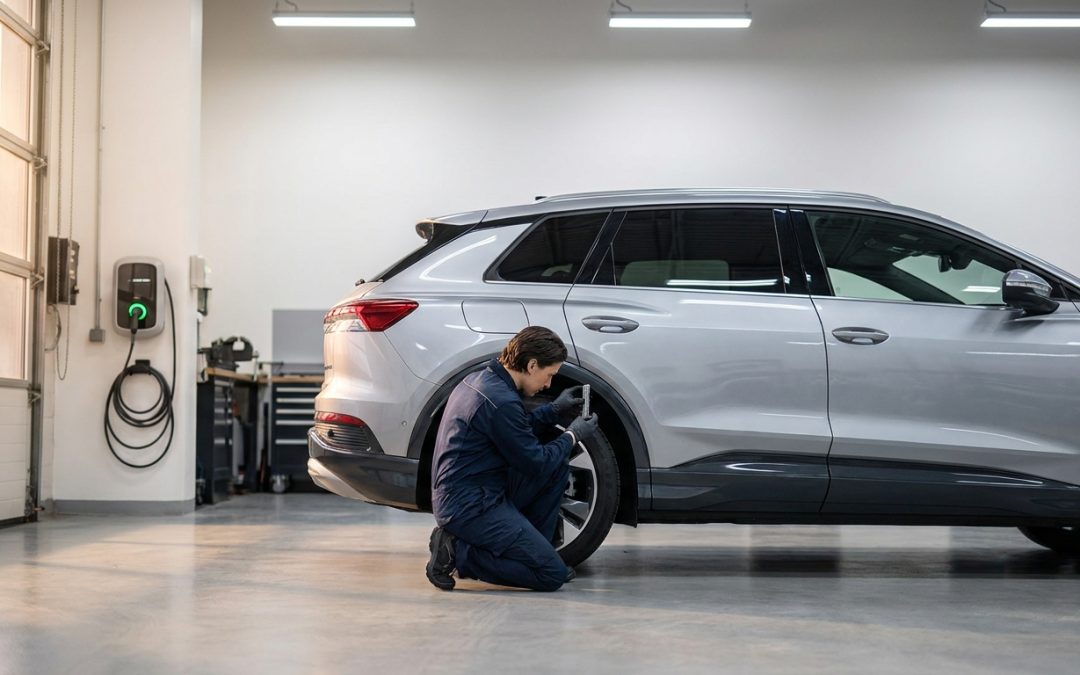
Electric vehicles (EVs) are quieter, smoother, and often quicker off the line than their gas-powered counterparts—but many new owners notice something unexpected: tires that seem to wear out sooner than they’re used to. If you’ve heard that “EVs eat tires,” you’re not alone. The real question is whether EVs truly wear out tires faster, and if so, why—and what you can do about it.
The short, accurate answer is: EVs can wear tires faster, but it’s not inevitable. Tire wear depends on a mix of vehicle design (weight, torque delivery, regenerative braking), tire construction, alignment settings, driving habits, and even local road conditions. Some EV drivers see normal tread life; others see noticeably shorter intervals between replacements.
This guide breaks down the mechanics behind EV tire wear, what’s different about EV-specific tires, how to spot premature wear patterns, and practical steps you can take to maximize tread life without sacrificing safety, range, or ride quality.
1) Why EVs Can Be Harder on Tires: The Big Factors
To understand whether EVs wear out tires faster, it helps to know what actually causes tire wear. Tires wear when rubber is scrubbed away by friction and heat. That friction comes from acceleration, braking, cornering, and road texture. EVs change the equation in a few important ways.
None of these factors automatically doom your tires—but together they can increase the rate of tread loss, especially if the vehicle is driven aggressively or the tires aren’t well-matched to the EV’s needs.
EV weight: batteries add pounds
Most EVs are heavier than similar-size gasoline vehicles, largely due to the battery pack. That extra mass increases the load on each tire. More load generally means more heat and more deformation (flex) in the tire as it rolls, particularly at lower pressures. Over time, that can accelerate wear.
For example, a compact EV may weigh several hundred pounds more than a comparable compact sedan. A midsize electric SUV can be substantially heavier than a non-electric SUV in the same class. Even when tires are rated to handle that weight, the added load can still increase wear—especially on the shoulders if inflation isn’t maintained.
Weight also compounds other wear factors: heavier vehicles require more force to accelerate, brake, and change direction. If you frequently drive in stop-and-go traffic or on twisty roads, the combination of weight and repeated load transfer can show up as faster tread loss.
Instant torque: quick launches can scrub rubber
EV motors deliver peak torque almost instantly. That’s part of what makes EVs feel so responsive. But when you apply that torque abruptly—especially from a stop—it can cause micro-slip at the contact patch, even if traction control prevents obvious wheelspin. That micro-slip is still friction, and friction removes rubber.
Drivers who enjoy brisk acceleration may see faster wear on the rear tires in rear-wheel-drive EVs, or more even but accelerated wear in all-wheel-drive EVs. The effect is often most noticeable in the first few feet of launch and during passing maneuvers where torque ramps quickly.
A practical real-world comparison: two drivers with the same EV and same tire model can experience very different tread life. The driver who uses “chill” acceleration and smooth throttle inputs may approach typical tread life expectations, while the driver who frequently uses maximum acceleration may shorten tire life significantly.
Regenerative braking: different braking forces, different wear patterns
Regenerative braking (regen) slows the car by using the electric motor as a generator, recovering energy back into the battery. This reduces reliance on the friction brakes, which is great for brake pad life—but it changes how deceleration forces are applied through the tires.
With strong one-pedal driving, the tires can experience frequent deceleration torque through the driven axle (often the rear or both axles, depending on the EV). That can contribute to uneven wear if alignment, tire rotation intervals, or driving style aren’t optimized. It can also increase wear in urban driving where deceleration events are constant.
Regen isn’t “bad” for tires on its own. The key is that EVs can apply both acceleration and deceleration torque through the drivetrain more often than a typical gas car, shifting more workload onto the tires during everyday driving.
Low rolling resistance vs. grip: trade-offs that affect wear
Many EVs come equipped with low rolling resistance (LRR) tires to improve range. LRR tires often use specialized compounds and construction to reduce energy loss as the tire flexes. Depending on the tire, this can mean less grip or a different treadwear balance compared to a performance-oriented all-season or summer tire.
Some LRR tires are designed to last; others prioritize efficiency and quietness, and may wear faster under high torque and high weight. On the flip side, switching to a grippier tire may improve traction and feel but can reduce range and sometimes accelerate wear if the compound is softer.
The takeaway: EV tire wear isn’t just about the vehicle—it’s about the system of vehicle + tire choice + driver behavior.
2) What the Data and Real-World Experiences Suggest
EV tire wear varies widely. Some drivers report replacing tires at 15,000–25,000 miles, while others reach 35,000–50,000 miles or more on the right tire and maintenance plan. That spread can be confusing, but it actually points to the same conclusion: EVs are more sensitive to certain variables.
It’s also important to separate two different ideas: (1) EVs can accelerate tire wear, and (2) EVs always accelerate tire wear. The first is often true; the second is not.
Why experiences differ so much
Driving style is the biggest divider. Instant torque makes it easy to drive quickly without realizing how much force you’re putting through the tread. Add strong regen and frequent stop-and-go, and the tires can be working hard almost constantly.
Road surface matters too. Coarse aggregate asphalt, chip-seal, and pothole-prone roads increase abrasion and can knock alignment out of spec. In many areas, winter freeze-thaw cycles create rougher surfaces and more impacts—both of which can shorten tread life.
Tire model and trim level also play a role. Performance trims with wider tires and softer compounds may wear faster than efficiency-focused trims. Even within the same brand, an OEM tire spec can differ from the replacement version sold retail (compound, tread depth, or construction), affecting both wear and noise.
Common patterns EV owners report
While outcomes vary, several patterns are common across many EV models:
- Faster wear on the driven axle (often rear tires on RWD EVs, or all four more evenly on AWD).
- Inside-edge wear if alignment has aggressive negative camber or toe settings, or if suspension components are stressed by weight and impacts.
- Rapid wear during the first half of tread life if drivers don’t rotate early and often—once uneven wear starts, it can accelerate.
- Noise increases over time as tread blocks feather or cup due to alignment or insufficient rotation.
These aren’t “EV-only” issues, but EV characteristics can amplify them.
Range, comfort, and cost: the three-way balancing act
EV owners often care about range more than gas drivers care about fuel economy, so they’re more likely to keep LRR tires or run higher tire pressures. That can help efficiency, but it can also make the ride firmer and increase center wear if pressures are too high for the load and tire design.
At the same time, EVs are quiet, so tire noise is more noticeable. Many EV-focused tires include foam inserts or tuned tread patterns to reduce noise. Those designs can influence wear and price. The result is a more complex buying decision: you’re not just buying tread life—you’re buying a blend of wear, noise, and efficiency.
Understanding that trade-off helps explain why some EV owners feel tires are “worse” when the reality is that the tire is optimized for a different priority than they expected.
3) EV-Specific Tires vs. Standard Tires: What’s Actually Different?
Not every EV needs an “EV tire,” but EV-focused tire designs have become more common for good reasons. Manufacturers have responded to EV demands: higher load, instant torque, quiet cabins, and efficiency targets.
If you’re shopping for replacement tires, knowing what makes an EV-oriented tire different can help you choose a model that lasts longer and performs better for your driving style.
Load ratings and reinforced construction
EVs often require tires with higher load indexes to safely handle the vehicle’s curb weight and passenger/cargo capacity. Many EV OEM tires use reinforced sidewalls or construction to manage weight while maintaining handling stability.
Using a tire with an insufficient load rating can lead to excessive heat buildup and accelerated wear (and it can be unsafe). Even if a lower-rated tire “fits,” it may not be appropriate. Always match or exceed the vehicle placard requirements for load index and speed rating.
Reinforced construction can also affect ride feel. Stiffer sidewalls can improve steering response and reduce squirm under torque, which can indirectly help wear by reducing tread distortion during acceleration and cornering.
Compounds tuned for torque and efficiency
EV tires may use compounds designed to reduce rolling resistance while maintaining acceptable grip under high torque. This is a tricky engineering problem: softer compounds can grip well but may wear faster; harder compounds can last longer but may lose traction or feel less confident in wet conditions.
Some EV tires aim for a middle ground by using silica-rich compounds for wet grip and efficiency, and tread patterns designed to distribute forces evenly. In practice, this can improve wear consistency—especially if you keep up with rotations and alignment.
However, not all EV OEM tires are long-wearing. OEM tires are sometimes selected to meet efficiency, noise, and ride targets for test cycles and first impressions. Replacement tires can outperform OEM in tread life if you choose a model with a strong treadwear warranty and proven real-world longevity.
Noise reduction features (and what they mean for wear)
Because EV powertrains are quiet, tire noise becomes a dominant cabin sound. Some tires include acoustic foam inside the tire to damp resonance. This doesn’t automatically change tread life, but EV tires may also use tread designs that reduce pattern noise.
The key wear-related point is that quiet tread patterns sometimes use smaller tread blocks or different sipe arrangements. Depending on the design, that can either help wear (more even contact) or hurt wear (more movement/heat). The best approach is to select a tire that has a track record on vehicles similar in weight and torque to your EV.
If you’re sensitive to noise, look for tires marketed for EVs or “touring” comfort, but confirm they meet load requirements and have a strong warranty. Quiet is great—until the tire wears unevenly and gets louder than anything you started with.
4) The Biggest Tire-Wear Triggers for EV Drivers (and How to Fix Them)
If EVs can wear tires faster, the good news is that most of the “extra wear” comes from a handful of controllable factors. Addressing them doesn’t require special tools—just consistent habits and a bit of awareness.
Below are the most common triggers we see, along with actionable fixes that can extend tread life and improve safety.
Aggressive launches and abrupt regen settings
Hard acceleration is fun, but it’s also one of the fastest ways to burn tread—especially on heavy vehicles with instant torque. Even when traction control prevents a full spin, the tire can still slip slightly at the surface, creating heat and abrasion.
Actionable tip: If your EV has drive modes (e.g., Chill/Eco/Normal/Sport), use a smoother mode for daily commuting. Save maximum acceleration for occasional situations. You can also modulate the pedal more gradually—smooth inputs preserve traction and reduce scrub.
On the regen side, very strong one-pedal settings can increase deceleration forces through the tires in city driving. That doesn’t mean you should avoid regen (it’s efficient and convenient), but you can experiment with a medium regen setting if your vehicle offers it, especially if you notice unusual wear on the driven axle.
Underinflation (the silent tire killer)
Underinflation is one of the most common causes of premature tire wear on any vehicle, and EVs are no exception. Low pressure increases rolling resistance (hurting range) and causes the tire shoulders to wear faster. It also increases heat, which accelerates rubber degradation.
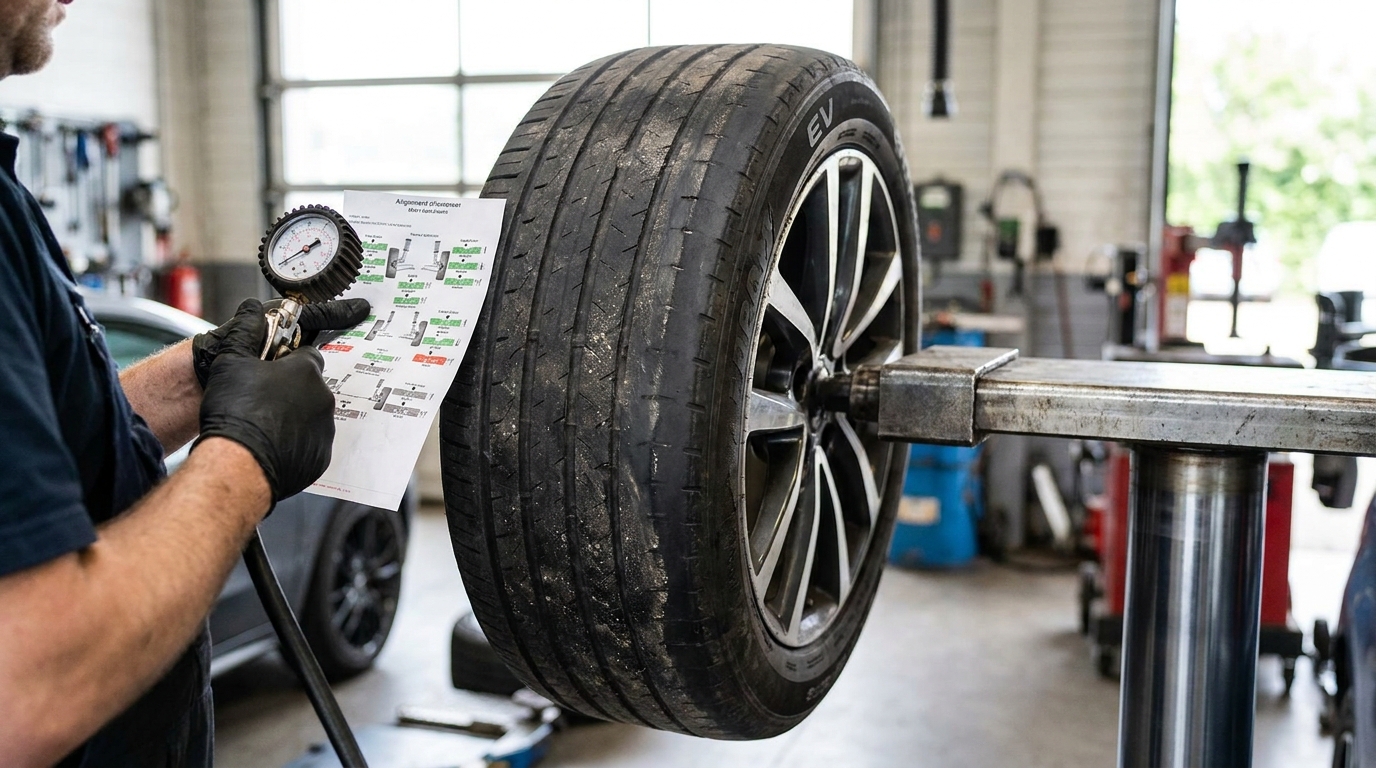
Actionable tip: Check tire pressure at least once a month with a quality gauge, and always check when temperatures swing. Tire pressure drops about 1 PSI for every 10°F decrease in ambient temperature. Many EVs display tire pressures, but a manual check helps confirm accuracy and catches slow leaks.
Don’t blindly overinflate for range. Excess pressure can cause center wear and reduce wet traction. Use the door placard as your baseline, then adjust only if you have a specific reason and understand the trade-offs.
Alignment and toe settings: small angles, big consequences
Alignment is one of the most overlooked causes of fast tire wear on EVs. Even slight toe misalignment can scrub tread continuously as you drive, acting like you’re dragging the tire sideways down the road. EV weight and torque can make the symptoms show up faster.
Real example: A driver replaces tires and skips alignment because the car “drives straight.” Within 10,000–15,000 miles, the inside edges are worn down while the rest of the tread looks fine. The culprit is often rear toe or camber out of spec—something you won’t always feel at the steering wheel.
Actionable tip: Get an alignment when you install new tires, after a significant pothole hit, or if you notice uneven wear, pulling, or a steering wheel that’s off-center. Ask for a printout of before-and-after measurements. If your EV has factory settings that are aggressive for handling, discuss whether a more tire-friendly setting is possible within spec.
Rotation intervals: EVs often need them sooner
Tire rotation is essential because EVs can load tires differently depending on drivetrain layout and regen behavior. If you wait too long, uneven wear patterns can become “locked in,” and rotating later won’t fully correct it.
Actionable tip: Rotate every 5,000–7,500 miles unless your owner’s manual specifies otherwise. If you drive aggressively or do mostly city driving, aim for the shorter end. For staggered setups (different sizes front/rear), rotation options may be limited—so alignment and pressure become even more critical.
After rotation, pay attention to changes in noise or vibration. Sometimes a tire with developing cupping becomes more noticeable when moved to a different axle. Catching that early can prevent a set of tires from becoming noisy long before the tread is gone.
5) How to Choose Tires for an EV: Longevity Without Sacrificing Safety
Choosing replacement tires for an EV isn’t just a matter of matching size. The “best” tire depends on what you value most: range, quietness, tread life, wet/snow traction, or sporty handling. The goal is to pick a tire that fits your priorities while meeting the EV’s load and performance requirements.
Below are practical guidelines to help you choose tires that last longer and perform well in the real world.
Start with the basics: size, load index, and speed rating
Always match the OEM tire size unless you have a specific reason to change (and you understand the impacts on range, speedometer accuracy, and clearance). More importantly, ensure the load index meets or exceeds the vehicle placard requirement. EVs are heavy, and the correct load rating is non-negotiable for safety and durability.
Speed rating should also meet the manufacturer’s requirements. Even if you don’t drive at high speeds, the speed rating often correlates with construction and heat resistance.
If you’re unsure, a tire professional can confirm fitment and appropriate load rating for your exact trim and wheel size.
Look beyond treadwear numbers: warranties and real-world reviews
UTQG treadwear ratings can provide a rough comparison within a brand, but they’re not perfectly consistent across manufacturers. A better indicator is a combination of:
- Treadwear warranty (e.g., 40,000–70,000 miles, depending on category)
- Real-world owner feedback on similar EVs (weight and torque matter)
- Category fit (touring all-season vs. performance all-season vs. summer)
Be cautious with very sporty tires if your priority is longevity. Performance compounds often trade tread life for grip. If you want a balanced option, a grand touring all-season tire with an EV-appropriate load rating is often a strong choice for daily driving.
Also consider that some OEM tires start with less tread depth than typical replacement tires, which can make them appear to “wear out faster” even if the wear rate is similar. When replacing, ask about starting tread depth and expected life for your driving conditions.
Consider EV-focused features—but don’t overpay for a label
“EV-ready” or “EV-specific” can be meaningful, especially for noise reduction and load handling. But the label alone isn’t a guarantee of long tread life. Some of the best tires for EVs are excellent mainstream models that simply happen to meet the load requirements and have proven wear characteristics.
Actionable tip: When comparing tires, ask these questions:
- Is the tire rated for my EV’s load index?
- What is the treadwear warranty and what are the conditions?
- How does it perform in wet braking and hydroplaning resistance?
- How will it affect range (rolling resistance) compared to OEM?
- Is road noise a common complaint as the tire ages?
If range is a top priority, stick closer to LRR-oriented models. If safety in heavy rain or winter slush is your priority, you may accept a small range hit for a tire with stronger wet/snow traction and predictable braking.
6) EV Tire Maintenance Checklist: Get More Miles From Every Set
Even the best tire can wear out quickly if it’s neglected. The upside is that a consistent maintenance routine can add thousands of miles to a set of tires—often more than switching brands will.
Use the checklist below as a practical, repeatable plan. It’s designed for EV realities: higher weight, strong torque, and frequent regen.
Monthly: pressure, quick inspection, and tread depth
Check tire pressure monthly (and before road trips). Use the recommended cold pressure on the door placard. If you routinely carry heavy cargo or passengers, confirm whether your manufacturer recommends pressure adjustments.
Do a quick visual inspection: look for shoulder wear, cracks, bulges, or embedded debris. EVs are quiet, so you may not hear a developing problem that would be masked by engine noise in a gas car.
Measure tread depth with a gauge. Don’t rely only on wear bars. Track tread depth over time (even a note in your phone). If you see one axle losing tread faster than the other, rotate sooner and consider an alignment check.
Every 5,000–7,500 miles: rotate and rebalance if needed
Rotate at consistent intervals. If your EV is AWD, rotating helps keep tread depths closer, which can also be important for drivetrain health and traction consistency.
If you feel vibration at speed, have the tires balanced. EVs deliver smooth power, so vibrations are often more noticeable. Ignoring them can contribute to cupping and uneven wear.
Real example: A driver notices a faint vibration at 65–75 mph and ignores it. Over time, the tread develops scalloped wear, increasing noise and reducing tire life. A simple rebalance early could have prevented the pattern from becoming permanent.
Seasonally: alignment check and driving habit reset
If you drive in areas with potholes, rough winter roads, or frequent construction zones, consider a seasonal alignment check—especially if you’ve had a hard impact. Alignment doesn’t have to be wildly off to cause rapid wear.
Also do a quick “habit reset.” Ask yourself:
- Am I launching hard more often than I realize?
- Am I relying on maximum regen in heavy stop-and-go traffic?
- Do I take corners aggressively because the EV feels planted?
Smoothing just one of those behaviors can meaningfully extend tire life without making driving boring. Many EVs still feel quick and responsive in Eco/Chill modes—you simply reduce the tire-scrubbing spikes of torque.
When replacing tires: don’t skip the “extras” that protect your investment
New tires are a significant expense, and EV tires can be pricier due to load requirements and specialized features. Protect that investment:
- Get an alignment with new tires (or at least verify alignment if wear on the old set suggests an issue).
- Replace worn suspension components if needed (bushings, control arms, etc.). Worn parts can cause rapid irregular wear.
- Confirm TPMS function so you’re alerted early to pressure loss.
- Register your tires for warranty if applicable, and keep rotation records.
These steps often cost less than the tread life you’ll lose by skipping them.
Conclusion: Do EVs Wear Out Tires Faster? Yes—But You Have Control
Electric vehicles can wear out tires faster than comparable gas vehicles, mainly due to higher vehicle weight, instant torque, and the way regen changes everyday acceleration and deceleration forces. But faster wear isn’t guaranteed. Many EV owners achieve solid tread life by pairing the right tires with consistent maintenance and smoother driving inputs.
Key takeaways:
- Weight + torque are the main reasons EVs can be harder on tires, especially with frequent hard launches.
- Regen braking changes wear patterns; it’s efficient, but it can increase workload on the driven axle in stop-and-go driving.
- Alignment, pressure, and rotations matter more than ever—small issues can translate into big tread loss on an EV.
- Choose tires with the correct load rating and prioritize a model that fits your goals (range, quietness, wet grip, tread life).
- Practical habits—monthly pressure checks, 5,000–7,500-mile rotations, and smoother acceleration—can add thousands of miles to a set.
If you treat tires as part of your EV’s performance and efficiency system—not just a consumable—you’ll get better range, safer handling, and longer-lasting tread. And when it’s time to replace them, selecting EV-appropriate tires and setting up a simple maintenance routine can make the next set last noticeably longer.